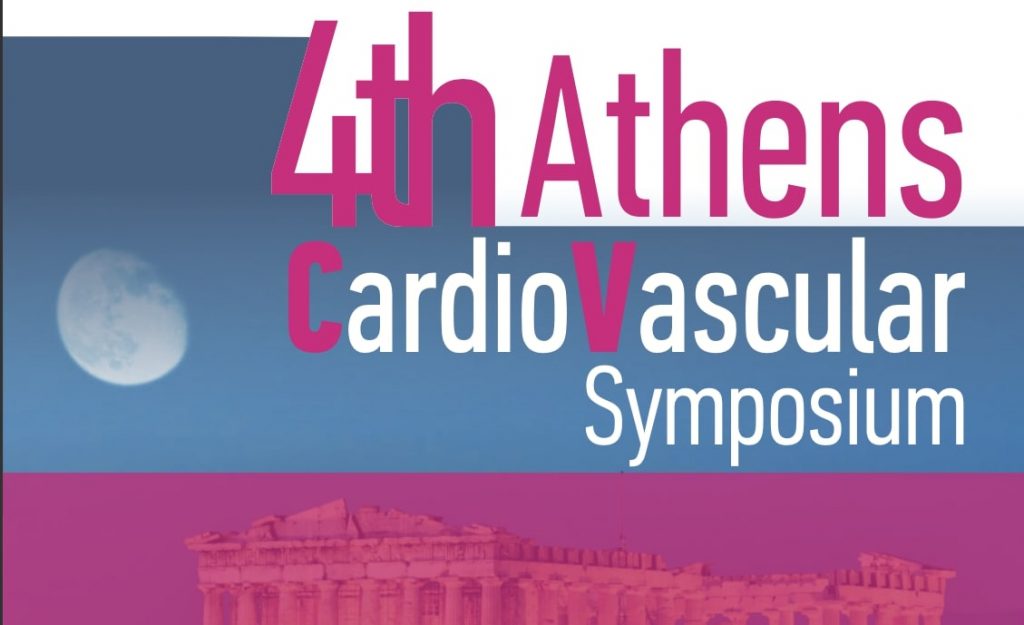
The 4th Athens Cardiovascular Symposium 2025 (4th ACVS) concluded on Saturday, 29 November 2025, with outstanding success. Held entirely in English, the event proved to be a genuinely global forum, bringing together eminent clinicians and scholars from Greece alongside a wide network of internationally renowned specialists, including J. Elefteriades, K. Plestis, K. Tsagakis, P. Punjabi, S. Abisi, S. Haulon, C. Shu, K. Tsilimbaris, A. Karelis, H. Elsayed-Awad, N. Sakalihasan, G. Pratesi, A. Kebriakov, R. Dammrau, M. Sabetai, T. Saratzis, C. Zeebregts, A. Svetlikov, G. Melissano, and J.P. Becquemin. Their engagement—either in person or virtually—was pivotal in establishing the symposium as one of the foremost scientific gatherings in the field of aortic surgery across Europe.
Through the mutual exchange of experiences and constructive scientific debate, the 4th ACVS provided a comprehensive approach to managing cardiovascular diseases, spanning the continuum from the aortic valve to the aortic bifurcation. The symposium highlighted the latest clinically relevant advances, emphasized the importance of interdisciplinary collaboration, and opened new horizons in light of the rapidly evolving scientific landscape.
The 4th ACVS also featured a competition for resident doctors, with 37 free paper presentations. The top three participants were awarded contemporary English-language textbooks on endovascular surgery. In total, 61 lectures were delivered, covering all aspects of aortic and aortic valve diseases.
The event was held under the auspices of the National and Kapodistrian University of Athens and the Hellenic Society of Vascular and Endovascular Surgery. We extend our sincere thanks to these institutions for their support. We are also grateful to the members of the organizing committee, Professors D. Angouras and A. Lazaris (Attikon University Hospital of Athens), Drs P. Dedeilias and T. Kratimenos (Evangelismos General Hospital of Athens), Professor K. Toutouzas (Hippokration General Hospital of Athens), Assistant Professor D. Avgerinos (Onassis Cardiac Surgery Center), Professor C. Karkos (Aristotle University of Thessaloniki), the Hellenic Society of Thoracic and Cardiovascular Surgeons, and the Chair of the Organizing Committee, Professor G. Geroulakos, for their outstanding contributions. Our thanks also go to everyone else involved in creating a scientific experience that exceeded all expectations.
![University of Athens Museums Bring Science and Society Together for International Museum Day [18 May]](https://hub.uoa.gr/en/wp-content/uploads/2026/05/ChatGPT-Image-13-Μαΐ-2026-03_15_08-μ.μ-1024x579-1.png)
![Sixth Symposium on Hypercompositional Algebra-new Developments and Applications (HAnDA) [25-29/05/2026]](https://hub.uoa.gr/en/wp-content/uploads/2026/04/Screenshot-2026-04-07-165950.jpg)