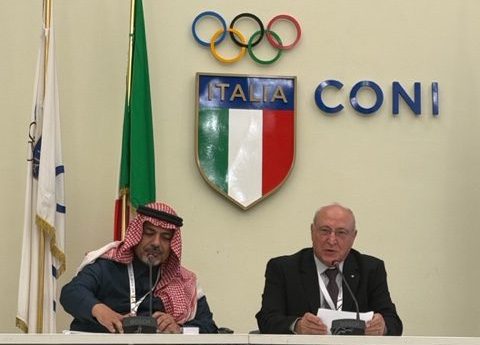
Professor Dimitris P. Panagiotopoulos, Professor at the School of Physical Education and Sport Science of the National and Kapodistrian University of Athens, participated as an invited keynote speaker in the 27th International Conference of the International Association of Sports Law (IASL) and joined the conference’s opening session.
His speech:
Dear friends and colleagues,
Ladies and Gentlemen,
Sport, as a truly international institution, has evolved into a multifaceted sphere of activity, characterized by complex and often challenging relationships. As this field has grown in scope and significance, so too have the problems and divergences that arise within it.
For thirty-three years, the International Association of Sports Law (IASL) has played a decisive role through sustained research, active engagement, and a meaningful contribution to the international scientific community and to global sport more broadly. During this period, a large number of scholars have demonstrated commitment and dedication to this field, a collective effort reflected in the organization of twenty-seven successful international conferences worldwide.
Through the work of IASL, many young legal scholars, as well as academic staff from universities across the globe, have been drawn to the theoretical study of sports law, while legal practitioners have increasingly engaged with it in practice. At the same time, experts from related disciplines—including sports scientists and professionals involved in the organization and administration of sport—have, for many years, shown a sustained and growing interest in Sports Law and lex sportiva.
Today, as at many critical moments in history, the values embodied in sport are being tested in multiple ways. This is particularly evident within the framework of the Olympic Games, the pinnacle of global sporting events, which must continue to promote the ideals and values of Olympia. For this reason, it is of fundamental importance to re-establish the Olympic Truce through an internationally recognized public institution. Such an endeavour, however, can only be realized through the creation of an international centre responsible for the economic governance and organization of the Olympic Games, supported by appropriate financial contributions and democratic participation, whereby each interested nation assumes responsibility for hosting the Games.
The challenges facing the legal regulation of international sporting entities and practices today are both significant and pressing. Safeguarding the human rights of athletes, coaches and all participants in sporting events, while ensuring legal certainty and integrity in sport, is of paramount importance. These objectives can only be achieved through the establishment of a robust and effective regulatory framework, including an International Constitutional Charter of Sport and a Code of Sports Ethics capable of responding to the demands of our time.
Allow me to draw your attention to the fact that, in the multipolar world now taking shape before us, a truly global sports system—including the Olympic Games—can only find meaning within the framework of an international amphictyony of nations. Such a system must be founded upon new structures and rules appropriate to this emerging world order, and underpinned by a constitutive legal framework: a strong and coherent body of International Sports Law.
This is a future worth striving for and committing ourselves to with determination.
The thirty-three-year journey of IASL stands as clear evidence of our willingness and ability to adapt our scholarly course in times of turbulence and to shape international sports law in ways that anticipate and address the challenges ahead.
It is in this spirit that I can offer nothing but optimism for the future that lies before us.
Thank you.


![‘We Are UoA’ Festival Welcomes New Students [Monday 12 October 2026]](https://hub.uoa.gr/en/wp-content/uploads/2026/09/afisa-we_are_uoa_2026_NEW_Dblue_page-00011-1024x717-1.jpg)
![Complete Anatomy Training Session [October 7, 2026]](https://hub.uoa.gr/en/wp-content/uploads/2026/10/NKUA_Invite-for-Complete-Anatomy-Training-Session_page-0001-1-1024x604.jpg)