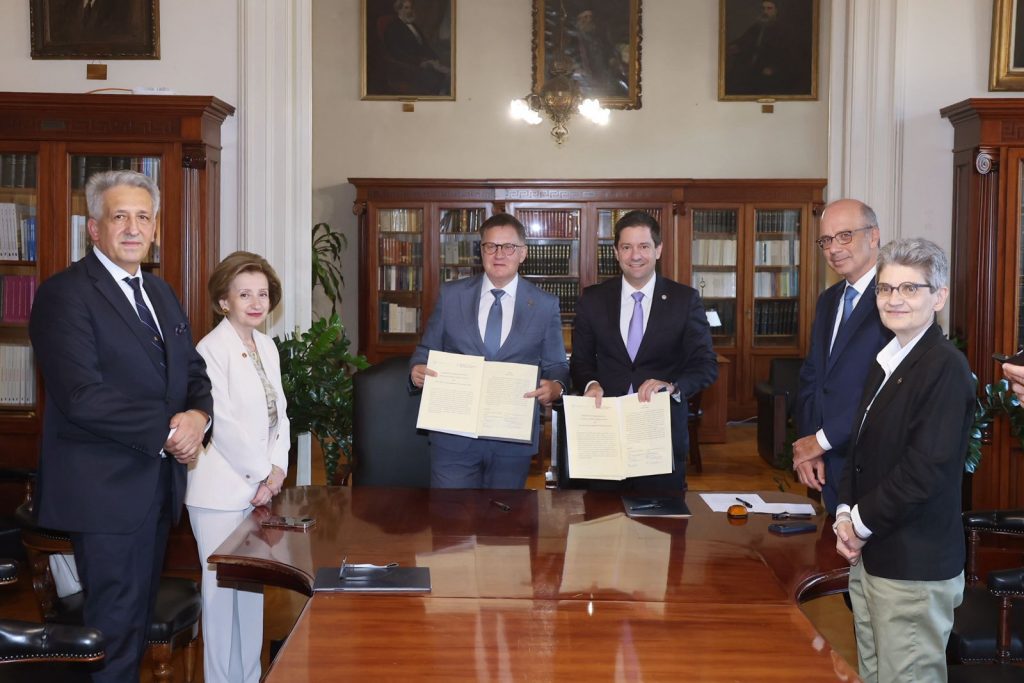


‘For the Hellenism of Cyprus, Greek education has always been a fundamental condition of survival and progress. In this light, the presence in Cyprus of a historic Greek university—heir to the Kapodistrian vision—assumes particular significance for the present and the future of our homeland. For this reason, we warmly congratulate the Rector, the academic staff, and all who have contributed to the realisation of this important undertaking. We wish the students every success in their academic pursuits and every strength as they prepare to offer their own creative service to society’, said, among other things, the Archbishop of Nova Justiniana and All Cyprus, Georgios, in his address at the event marking the founding and operation of the National and Kapodistrian University of Athens – Cyprus Branch.

The full address by the Archbishop is below:
‘It is with unfeigned joy that I rise to greet today’s gathering, organised on the occasion of the launch of academic programmes of the National and Kapodistrian University of Athens in Cyprus.
This day carries particular significance for Cyprus and for the wider Hellenic world beyond the borders of the Greek state. The presence of the National and Kapodistrian University of Athens in Cyprus constitutes an event not only of academic but of historical importance. It transcends the narrow confines of institutional expansion and is inscribed within the long-standing tradition of intellectual bonds between the University of Athens and the Hellenism of Cyprus.
Since its foundation in 1837 as the first university of the Greek nation, the National and Kapodistrian University of Athens has stood as a cornerstone of higher learning and of the intellectual regeneration of Hellenism. Its association with the name and vision of Ioannis Kapodistrias speaks to its deeper vocation—one extending beyond the transmission of knowledge to the formation of character, social responsibility, and national consciousness.
That vocation has long been felt, and continues to be felt, in Cyprus. For many years, the University admitted Cypriot graduates of the six-year secondary schools—today’s Lyceums—to all its academic programmes without entrance examinations and without numerical restriction, irrespective of the grades on their school leaving certificates, at a time when students from Greece itself competed fiercely for a limited number of places in certain Departments. Even today, entry examinations for Cypriot candidates are conducted locally for the places allocated to them. The principal difference is that the number of such places is now proportionally defined, owing to the existence of other Greek universities which likewise welcome Cypriot students.
We all recognise the profound impact this had upon the preservation of national self-awareness, of Hellenic ethos, and of the Greek way of life within our society. During the period of colonial rule, incentives were offered for study in the United Kingdom, with the clear aim of reshaping the cultural orientation of the island. It was anticipated that Cypriots educated there would adopt a British ethos and, upon returning home, would transmit it through our schools and institutions.
In that context, the role of Greek university education proved decisive. It acted as a bulwark against such designs and as an institutional safeguard of national resilience, at a time when education itself had become an arena of ideological and cultural contestation.
Throughout the years of British rule, the Church of Cyprus stood as the principal support and foremost representative of Cypriot Hellenism. In heading that historic institution today, I express my sincere and abiding gratitude to the National and Kapodistrian University of Athens for its steadfast stance and its enduring contribution to the national and spiritual survival and advancement of Cyprus.
The University’s high academic standing is internationally acknowledged and is reflected both in its scholarly output and in the consistent calibre of its graduates. It has long been, and remains, a place where scientific excellence, critical thought, and responsible public engagement are cultivated.
I count it a personal blessing to have studied in two of its Departments. In the course of my subsequent postgraduate studies in England, I came fully to appreciate the exceptionally high standard of learning that the University of Athens had afforded us.
For the Hellenism of Cyprus, Greek education has always been a fundamental condition of survival and progress. In this light, the presence in Cyprus of a historic Greek university—heir to the Kapodistrian vision—assumes particular significance for the present and the future of our homeland.
For this reason, we warmly congratulate the Rector, the academic staff, and all who have contributed to the realisation of this important undertaking. We wish the students every success in their academic pursuits and every strength as they prepare to offer their own creative service to society’.


![Complete Anatomy Training Session [October 7, 2026]](https://hub.uoa.gr/en/wp-content/uploads/2026/10/NKUA_Invite-for-Complete-Anatomy-Training-Session_page-0001-1-1024x604.jpg)