
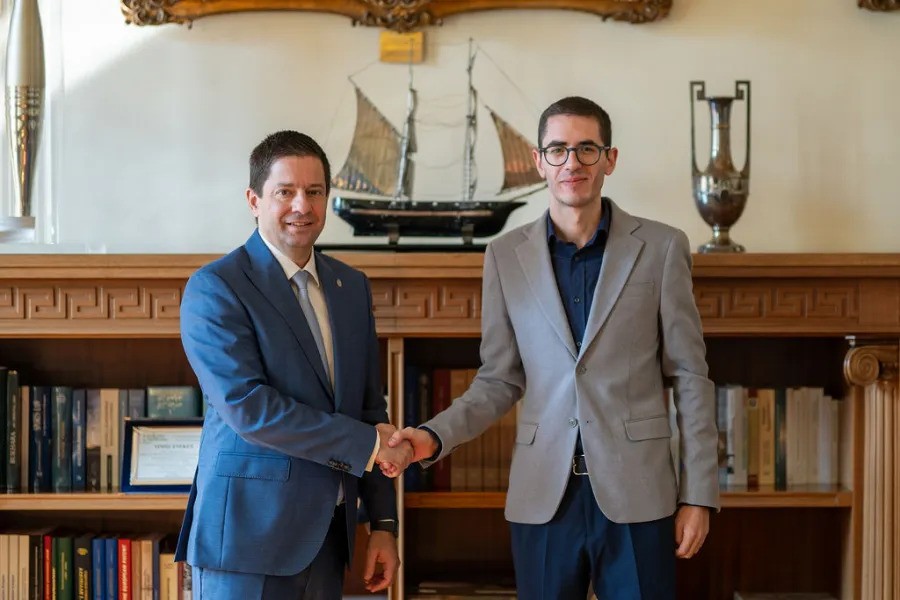
The Rector of the National and Kapodistrian University of Athens and President of the Hellenic Universities Rectors’ Conference, Professor of Cardiology Gerasimos Siasos, welcomed alfavita.gr to the University’s historic Main Building at the Propylaea. There, he spoke to journalist Nikos Lourdas for the publication’s Vidcast series.
The wide-ranging interview touches on his own journey from medical student to Rector, but its main focus is the University of Athens today: its achievements, its challenges and its plans for the years ahead.
Among the issues discussed are a €130 million donation to support the renovation of facilities, the appointment of 507 new assistant professors over the past three years, and the University’s network of partnerships with 800 higher education institutions in 70 countries.
Professor Siasos also outlines plans to renovate all student halls of residence and create a major conference centre on the Zografou Campus, while revealing that two further Schools feature in the University’s strategic plans.
The discussion also covers the University’s branch in Cyprus and its internationalisation strategy; partnerships with institutions including Harvard, Yale and the Sorbonne; student accommodation and state funding; university autonomy; the possible creation of new Schools; and Artificial Intelligence, which, as he puts it, ‘is not the future; it is the present’.
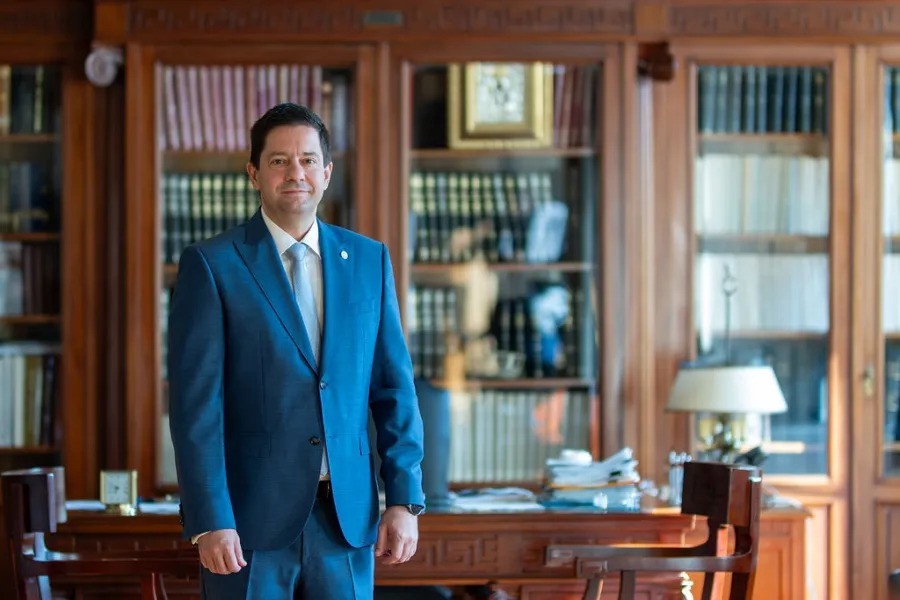
From an 18-year-old medical student to the Rector’s Office
The interview opens with Professor Siasos’s own story.
In 1997, he entered the Medical School of the University of Athens after gaining admission through the national university entrance examinations. At the time, could he have imagined that he would one day lead not only the School, but the University as a whole?
For an 18-year-old, being admitted to Medical School already felt like the fulfilment of a dream.
He recalls growing up in a family of civil servants with no connection to either the University of Athens or medicine. Being admitted to Medical School was, he says, ‘the greatest achievement’ he could have imagined at that age.
Almost three decades later, that first step has led him to the University’s highest office.
190 years of the University of Athens: ‘There would be no country without the University of Athens’
His personal story soon gives way to that of the institution he now leads.
As the University of Athens celebrates its 190th anniversary, Professor Siasos reflects on the University’s place in the history of the modern Greek state.
Following the Greek Revolution, he notes, the University of Athens was the country’s only university and soon became a key pillar in educating the people who went on to serve the new state.
He sees that history as part of a continuing responsibility. The University, he argues, has traditionally served as an ‘intellectual leader’, helping to cultivate critical thinking and support the development of democratic institutions. For him, that fundamental mission remains unchanged.
Which University of Athens figure would he welcome back as a first-year student?
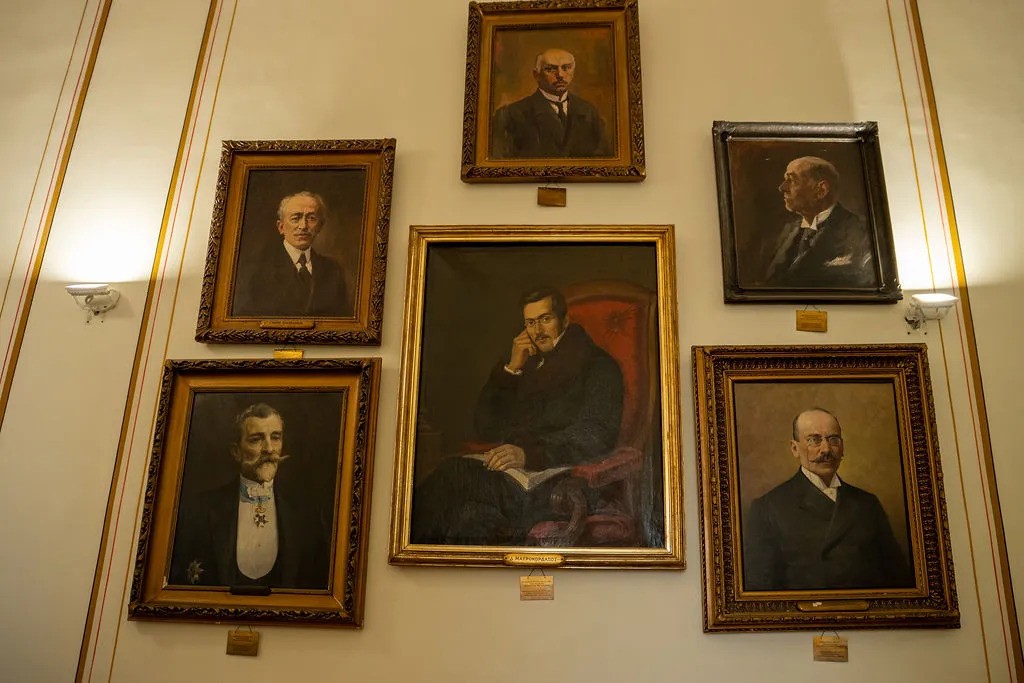
Speaking inside the Propylaea, it is perhaps inevitable that the conversation turns to some of the many prominent figures associated with the University.
Professor Siasos names, among others, Odysseas Elytis, Giorgos Seferis, Kostis Palamas, Nikos Kazantzakis, Manolis Andronikos, Amalia Fleming, Maria Polydouri, Eleftherios Venizelos, Charilaos Trikoupis and Ioannis Kapodistrias.
Asked which of them he would most like to meet today as a first-year student at the University of Athens, he chooses Kostis Palamas.
507 new assistant professors in three years
Asked what he regards as the most significant change at the University of Athens over the past three years, Professor Siasos does not point to a new building or a major construction project. His answer is people.
According to figures cited in the interview, 507 new assistant professors have been appointed over the past three years, representing roughly one third of the University’s academic staff.
A number of those appointed have returned to Greece after working at leading universities and research institutions abroad.
For Professor Siasos, the renewal and strengthening of the University’s academic community is one of the most important developments of his administration so far.
Cyprus: ‘Perhaps the University’s biggest step towards internationalisation’
The University’s presence in Cyprus occupies a prominent place in the discussion.
Professor Siasos explains that the decision to establish the University’s branch in Cyprus was unanimously approved by the Senate during the first academic year of the current administration.
Other locations had been considered, but Cyprus ultimately emerged as the choice because of its long-standing historical links with the University of Athens.
As he points out, tens of thousands of University of Athens graduates have, over the decades, contributed to life in Cyprus, working in its schools and hospitals and playing a role in its political life.
Now in its second year of operation, the branch represents, in his view, a natural continuation of that relationship.
He describes it as ‘perhaps the biggest step towards internationalisation that the University has taken’.
A viral video and the reality behind the University’s facilities
The conversation then turns to something much more immediate for students: the condition of the University’s buildings and facilities.
The starting point is a viral video showcasing the renovated spaces of the School of Philosophy. Some social media users even joked that the footage looked as though it had been generated by Artificial Intelligence.
Professor Siasos responds with a smile that ‘it wasn’t Artificial Intelligence’, but he quickly shifts the focus to what matters most to him: the reaction of the students.
‘There is no greater reward for a teacher, for an academic, than seeing the joy on a student’s face and hearing them say thank you.’
There is, however, no attempt to disguise the scale of the task ahead.
‘The state of the University (…) is not what we want it to be.’
The University of Athens has almost one million square metres of buildings and facilities. Many date back 50 or 60 years, while some are as old as the University itself.
Years of reduced funding during the economic crisis also took their toll on maintenance, leaving many facilities in need of substantial investment.
In recent years, renovation work has been carried out at the School of Law, the School of Philosophy, the School of Science and the School of Theology, as well as in toilet facilities on the University Campus. A total of 32 previously occupied spaces have also been cleared and converted into libraries, gyms and other facilities for students, while work is under way on the Campus sports facilities.
A €130 million donation to transform University facilities
The scale of the challenge makes the University’s latest plans particularly significant.
The key development is a €130 million donation from Greece’s four systemic banks through the Hellenic Bank Association.
Professor Siasos describes the funding as a major opportunity to address the condition of the University’s buildings and facilities. The aim is to renovate all Schools and Departments over the next four years.
The plans extend beyond existing buildings. A major modern conference centre is also planned for the Zografou Campus, adding a new dimension to the University’s facilities and its capacity to host major academic events.
1,200 places in student halls of residence for more than 40,000 students
Student accommodation remains one of the University’s most pressing challenges.
Professor Siasos describes the housing crisis as ‘a very serious problem’, not only for the University of Athens but for Greek society more broadly.
Through the Youth and Lifelong Learning Foundation, plans are in place to renovate all University of Athens student halls of residence.
One of the four student halls of residence is already undergoing renovation, with funding from the Ministry of Education, the University of Athens and the European Union. The work is expected to be completed by the end of the year.
Even after the renovations, however, demand will continue to outstrip supply.
The University of Athens currently has just over 1,000 places in its student halls of residence – approximately 1,100 to 1,200 – for a population of more than 40,000 active undergraduate students.
‘We will still be short of places, and we need to invest more in the future’, Professor Siasos acknowledges.
ASPETE and two further Schools in the University’s plans
The University’s future academic structure also features prominently in the interview.
Professor Siasos refers to the unanimous decision, taken two years ago, to incorporate the School of Pedagogical and Technological Education (ASPETE) into the University of Athens. The proposal has been approved by both institutions but is still awaiting the necessary legislation.
He openly expresses his frustration at the delay, noting that the University has been waiting for the relevant legislation for at least a year.
There are further plans beyond ASPETE.
Two additional Schools are also envisaged as part of the University’s strategic plans for the next four years.
Professor Siasos does not reveal which fields they will cover, stressing that the relevant university bodies must first consider and approve the proposals.
From €40 million to €9 million – and now €15 million
The interview also addresses the wider question of funding for Greece’s public universities.
Professor Siasos argues that Greek universities have continued to perform strongly internationally despite years of underfunding. He illustrates the scale of the change with the University of Athens’ regular state funding.
Before the economic crisis, the University received more than €40 million in regular state funding. That figure subsequently fell to €9 million. It now stands at approximately €15 million, while the University’s operating costs are around €20 million.
The immediate priority, therefore, is to bring regular state funding up to a level that at least covers the University’s operating costs.
Professor Siasos also notes that funding has increased by approximately 50% over the past four years, although it remains below pre-crisis levels.
What do the Rectors want from the government?
As President of the Hellenic Universities Rectors’ Conference, Professor Siasos also speaks about the issues on which university rectors across the country are seeking change.
One concerns the application of the ‘one-for-one’ principle to staff departures.
At present, he explains, academic staff who leave are replaced by new appointments, with the number of new academic positions in recent years even exceeding the number of departures.
The same arrangement does not apply to other categories of university staff, including members of the Laboratory Teaching Staff, Special Technical Laboratory Staff and administrative staff.
The Rectors’ Conference is therefore calling for the one-for-one replacement principle to be extended to all staff categories.
The second issue is university autonomy.
Professor Siasos is critical of Law 4957/2022, which he describes as an example of ‘over-regulation’. His argument is that the legislation attempts to regulate too many aspects of university life, leaving individual institutions insufficient room to operate in accordance with their own history, structures and governing bodies.
In his view, the result is unnecessary bureaucracy.
800 universities in 70 countries – Harvard, Yale, the Sorbonne and Boston University
Internationalisation is another central theme.
Professor Siasos says that, over the past three years, the University of Athens has expanded its network of international partnerships through memoranda of understanding and collaborations in teaching and research.
Among the institutions he mentions are Harvard, Yale, the Sorbonne and the University of California, Santa Barbara.
He also announces that a University of Athens delegation is due to travel to Boston University next month to sign agreements covering joint educational programmes.
The University’s international network is now considerably broader.
According to Professor Siasos, the University of Athens has active agreements with 800 higher education institutions in 70 countries.
Artificial Intelligence: ‘It is not the future; it is the present’
Artificial Intelligence is another area in which Professor Siasos sees the University having to respond now rather than later.
‘Artificial Intelligence is not the future; it is the present. We are living it.’
The University has already organised training programmes for academic and administrative staff on the use of AI in teaching and administrative work.
The University is also preparing regulations governing the use of Artificial Intelligence, which are expected to be submitted for approval. A dedicated committee has already been established to address the issue.
From Sotiria Hospital to the Propylaea – a day that ends late
Towards the end of the interview, the focus shifts from institutional priorities to the practical realities of Professor Siasos’s own life.
How does he combine medicine, the Rector’s Office, his responsibilities as President of the Rectors’ Conference and family life?
His working day begins at 8 a.m. at Sotiria Hospital, where he continues to work in the Department of Cardiology.
He tries to devote two to three hours a day to practising cardiology and medicine.
At around 10.30 or 11 a.m., he heads to the University, where the second part of his working day begins.
His duties in the Rector’s Office often keep him there until ‘very late’ in the evening.
Asked whether there is still time left for being a father – or simply for being ‘Gerasimos’ – he gives an answer that makes no attempt to disguise the demands of the role.
‘There is no time, unfortunately.’
Then he adds:
‘That is the price.’
If he could meet his 18-year-old self
Nearly three decades after entering the School of Medicine, Professor Siasos is finally asked to look back at the young man who began that journey in 1997.
What would he tell his 18-year-old self?
Work hard.
Rely on the people around you.
Do not lose sight of your friends, whatever success may come your way.
Help people.
And have a vision.
‘With vision and hard work, you really can change the world’, he says.
There is one final question, this time in the opposite direction.
What would that 18-year-old student say to the Rector standing before him today?
His answer brings the interview full circle:
‘Keep working, because there is still so much that needs to change.’
And that leads back to the question at the heart of the discussion.
Can a 190-year-old university really change within four years?
The answer cannot be found in a single interview.
It will be seen in lecture theatres and laboratories, in student halls of residence and libraries, in historic buildings being renovated and in the new Schools being planned. It will be reflected in academics returning from abroad and in the students walking through the University gates for the first time.
Ultimately, the measure of that change will be found in the everyday experience of the people for whom all these efforts are intended: the students themselves.
Watch the full interview with Rector Professor Gerasimos Siasos as part of alfavita.gr’s Vidcast series.
![Complete Anatomy Training Session [October 7, 2026]](https://hub.uoa.gr/en/wp-content/uploads/2026/10/NKUA_Invite-for-Complete-Anatomy-Training-Session_page-0001-1-1024x604.jpg)

![‘Dialogues for Athens’ Conference Organised by TO VIMA Under the Auspices of the National and Kapodistrian University of Athens and the Municipality of Athens [6-7 October]](https://hub.uoa.gr/en/wp-content/uploads/2026/10/Untitled-Design2-1-1024x576-1.jpg)