The Time After the Genocides: What To Build Anew? What to Remember? What To Transmit To the Next Generation?1
The third and final academic encounter of Odette Varon-Vassard’s and Hervé Georgelin’s research program at the École Française d’Athènes took place in the premises of the École at Didotou 6. The focus of this last meeting was the time of reconstruction, elaboration and possible transmission after the major historical ruptures that were the traumatic events of 1915 in the Ottoman Empire and 1942 in Nazi-occupied Europe.
It is often even unknown to young students at the National and Kapodistrian University of Athens that the population of Greece does not comprehend only citizens of Greek-Orthodox origins or faith. Beside this majority, others are present among us with a different background and partly different history than the bulk of the population. This remark is pertinent to the whole of the Balkans. Jews and Armenians have been living in the peninsula for centuries and are still active in this geographic zone, despite all odds.
The research program was organized in three steps. The first one was dedicated to the life in non-national political frames: in the Habsburgs’ and the Ottomans’ Empire. We started our activities in November 2022.2 This is considered as a Golden Age for both populations, most of the time at ease with dynastic loyalties and geographic mobility on vast territories in a legal frame of relative community-based internal autonomy. These Golden Ages were brought to a cruel end. This was our second meeting which took place in November 2023. As far as Armenians are concerned, they have been targeted by the anti-Armenian persecutions in the Ottoman Empire (Hamidian massacres in 1894-1896, massacres in Adana in 1909) and the scheme of radical extermination implemented the Young-Turks (starting in 1915 by massacres and a massive expulsion – tehcir – and taking new vicious forms in the Syrian deserts in the subsequent years – renewed deportation, sevkiyat, and slaughters – katil). In the case of Jews, the German occupation of South-Eastern Europe and the decision of the Conference of Wannsee (January 1942), best exemplified by the deportation of the Jews in Salonica in 1943.3
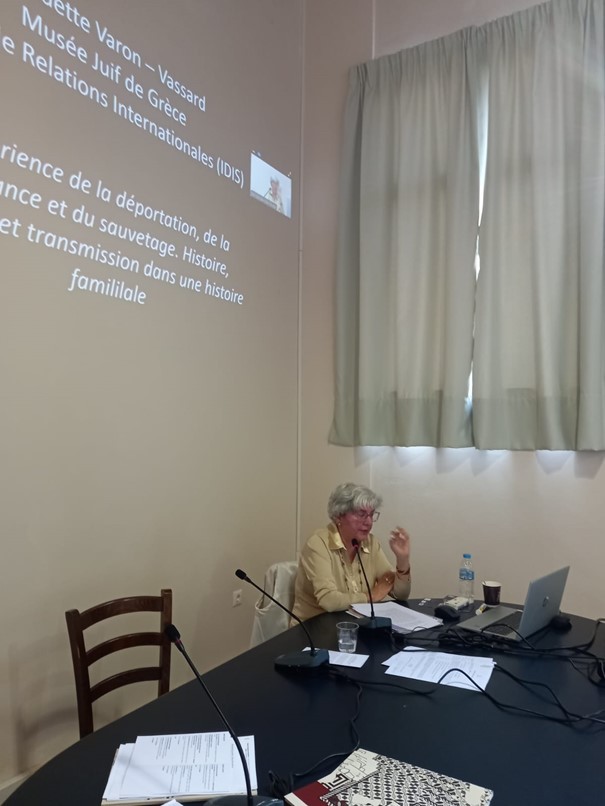
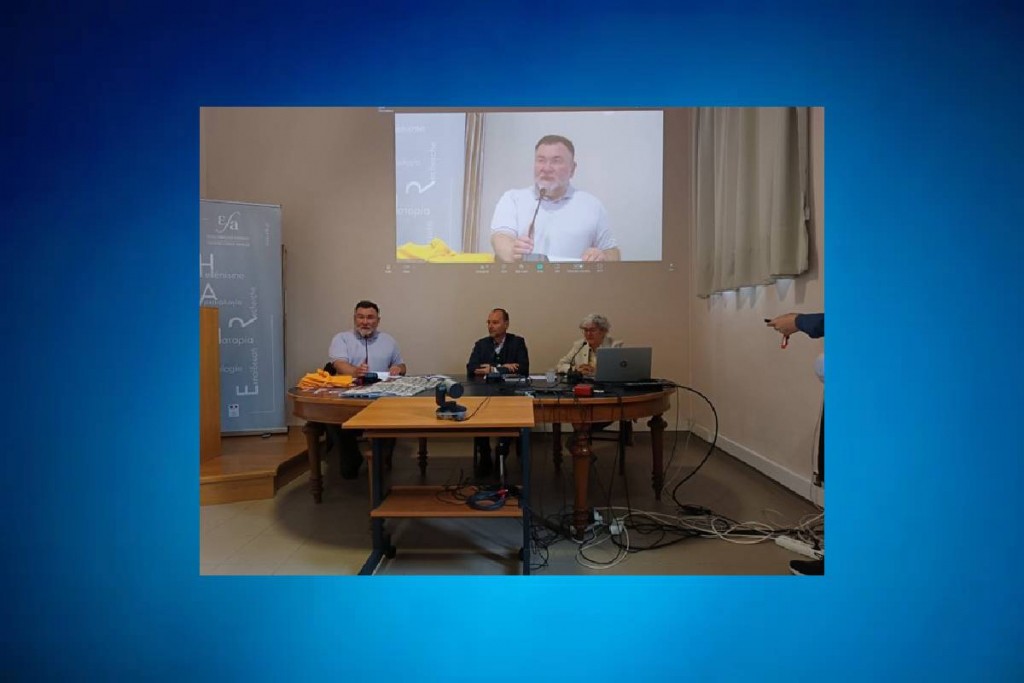
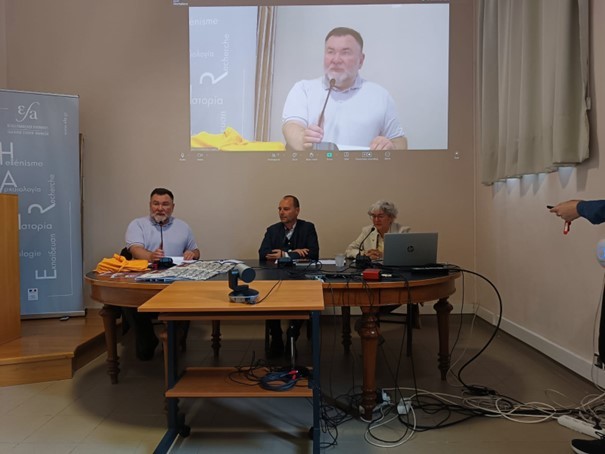
The third encounter which has just taken place on May 16-17, 2024 was designed to address the possibility of survival after the extermination, for the few survivors and their possible heirs. The third meeting was defined by its interdisciplinarity, and aimed at provoking discussions between historians, linguists, professional of the psychoanalytic field and a sociologist. Speakers from different places – Paris, Berlin – from different geographical backgrounds – France, Turkey, Serbia, Greece, Lebanon, Poland – gathered in Athens with their Athenian colleagues. The four sessions were well attended. The program was co-financed by the Foundation Gulbenkian located in Lisbon,4 and the SEDYL, a joint laboratory at the INALCO and the CNRS of linguistics,5 supported the travel fees of one speaker.
Annette Wieviorka was our very first keynote speaker.6 The renowned historian, specialist of the extermination of the European Jews, drew a general panorama of the current situation of her topic in the present times. Because of demographic changes in Europe and the new conflicts in Israel / Palestine inaugurated by intolerable crimes in October 2023 and the current Israeli military campaign in the Gaza Strip, the Shoah is being trifled and relativized in countries where heirs of Jewish survivors are living, putting their safety in the Diaspora and the Near East in question. The second speaker was my colleague Odette Varon-Vassard.7 Following the difficult path of microstoria, Odette plunged us into the lethal waters of Nazi-occupied Greece and the divergent itineraries of branches of her own families. Some being saved of deportation in a dual procedure combining their own agency but also the help of righteous Greek-Orthodox and others being deported and assassinated.
Our second session was devoted to the languages of the targeted groups. Anaïd Donabédian-Demopoulos sketched the survival of Western-Armenian (արեւմտահայերէն) in different contexts: the purist institutional framework established in Syria-Lebanon, the social margin in democratic France, the margins left by the community-centered structures in the US resulting in the slow or rapid decline in command of vernacular Western Armenian. Greece is a mixed model where fluency is not lost and the few active schools (the middle school in Nikaia especially8) are motivated by renewing their pedagogical approach. Bulgaria stands in contrast outside of the chain of language transmission. Željko Jovanović spoke about the maintenance or/and disappearance of Judeo-Spanish (djudezmo) as witnessed and experienced by three Jewish authors of Serbia, Bosnia and Northern Macedonia. The third occurrence, Jamila Kolonomos (1922-2013) was a striking example of literary production in djudezmo in Yugoslav Skopje, while the whole Jewish community had been exterminated (but a few persons) except for a few individuals/people and the language silenced. Her works has to find readers elsewhere and/or among specialists or must be translated in other languages to reach a readership.
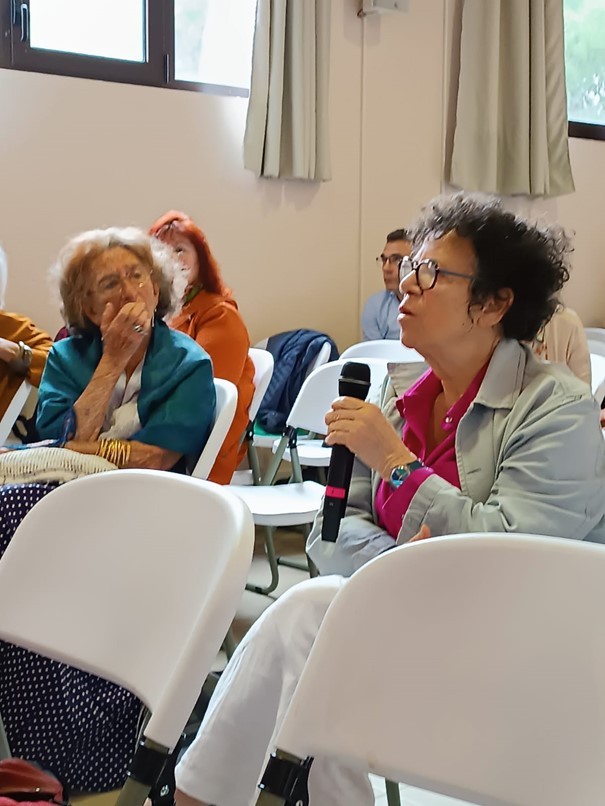
Friday 17 May 2024 started with a session focusing on traces of the trauma at the psychological level. Janine Altounian, as second keynote speaker, sketched her own life as an example of trauma elaboration thanks to the Freudian psychoanalytical method and the integration among French society which offered her an escape from the trauma-stricken Armenian milieu in which she was born. French public education, French culture, access to German Studies and finally to psychoanalysis enabled her to be the coordinator and co-translator of the recent complete publication of Sigmund Freud’s works translated into French at the Presses Universitaires de France.9 Ariella Asser, our second speaker, evoked the traces of the Shoah in her psychoanalytical practice.10 Patients of different backgrounds come to her with unconscious motives related to the extermination of the European Jews, which they have to elaborate on in order to improve their psychological health and their present interaction with social, economic and in-terpersonal reality.
Our last session, under the presidency of Emilie Themopoulou, my historian colleague at the Department of Turkish Studies and Contemporary Asian Studies at the University of Athens,11 was focused on Armenian survivors. Nazlı Temir-Beyleryan spoke of the situation of Armenians in today’s Turkey.12 She clearly exposed the three regimes of memory they have been compelled to live in until today. In a first period from 1923 to 1965, Armenians had to live in the imposed silence and the general taboo about the Armenian history in Turkey and especially the genocide inflicted on the group from 1915 onward. After Armenian mobilization and terror attacks on the part of the ASALA replaced the genocide of 1915 in the present, from the 1960s onward, Armenians in contemporary Turkey had to face the denialist discourse of official Turkey finding support in academia but also in official Armenian structures in this country. At the end of the 1990s, efforts from the civil society and at the beginning of the 2000s, some bold academic initiatives seemed to have once and for all altered the compulsory silence and/or denialist rhetorics,13 enabling local Armenians to speak more freely within their families, their community-based institutions and the society at large. The role of the weekly AGOS is not to be underestimated in this process. The situation of the neighbouring country cannot guarantee that these changes are definite or not. Our last speaker, Vahé Tachjian,14 exposed some findings of his surveys in Greece and elsewhere among Armenian families that are the core of some publications on the website www.houshamadyan.org. The Greek Armenians have some specificities in the Diaspora: they consider time with a major rupture in 1922 and put less emphasis on 1915. Most of them originate in Western Asia Minor and came to Greece with the mass exodus of Greek Orthodox Ottoman subjects expulsed by Mustafa Kemal in late September 1922. They also were especially targeted by the Nazi-occupation of Greece because they were prone to resist the German tyranny. Many of them were among the so-called “repatriated” Armenians of the Diaspora after WW2.
This was once again a dense program and it has to have as more permanent fruit the publication of a collective volume, edited by Odette Varon-Vassard (Jewish Museum of Greece) and Hervé Georgelin – assistant professor at the Department of Turkish Studies and Contemporary Asian Studies at the National and Kapodistrian University of Athens. The head of the École Française d’Athènes, Véronique Chankowski, is supporting this editorial project.
[1] https://www.efa.gr/events/25456/
[2] https://www.efa.gr/events/18-11-2022-armeniens-et-juifs-au-temps-des-empires/
[3] https://www.efa.gr/events/armeniens-et-juifs-la-rupture-traumatique-des-genocides/
[4] https://gulbenkian.pt/en/
[5] https://sedyl.cnrs.fr/presentation/
[6] https://www.babelio.com/auteur/Annette-Wieviorka/31154
[7] https://biblionet.gr/%CF%80%CF%81%CE%BF%CF%83%CF%89%CF%80%CE%BF/?personid=9
[8] https://armenika.gr/koinotita/174-sxoleia/882–lr–90-
[9] https://www.puf.com/oeuvres-completes-de-freud
[10] https://biblionet.gr/%CF%80%CF%81%CE%BF%CF%83%CF%89%CF%80%CE%BF/?personid=10844
[11] https://biblionet.gr/%CF%80%CF%81%CE%BF%CF%83%CF%89%CF%80%CE%BF/?personid=70118
[12] https://www.editions-harmattan.fr/livre-la_memoire_collective_des_armeniens_de_turquie_du_genocide_au_memoricide_nazli_temir_beyleyran-9782140309458-76987.html
[13] https://www.chronicle.com/article/academic-conference-in-turkey-on-armenian-question-is-canceled-under-government-pressure/ and https://www.tert.am/en/news/2015/04/27/stambul/1658728
[14] https://www.babelio.com/auteur/Vahe-Tachjian/54160
![Complete Anatomy Training Session [October 7, 2026]](https://hub.uoa.gr/en/wp-content/uploads/2026/10/NKUA_Invite-for-Complete-Anatomy-Training-Session_page-0001-1-1024x604.jpg)
![‘Dialogues for Athens’ Conference Organised by TO VIMA Under the Auspices of the National and Kapodistrian University of Athens and the Municipality of Athens [6-7 October]](https://hub.uoa.gr/en/wp-content/uploads/2026/10/Untitled-Design2-1-1024x576-1.jpg)