
Branding Mediterranean Europe: Tourism, Transport, and National Identity, 1945-1990
Institute for Mediterranean Studies, Rethymno, Crete, 8-10 June 2023
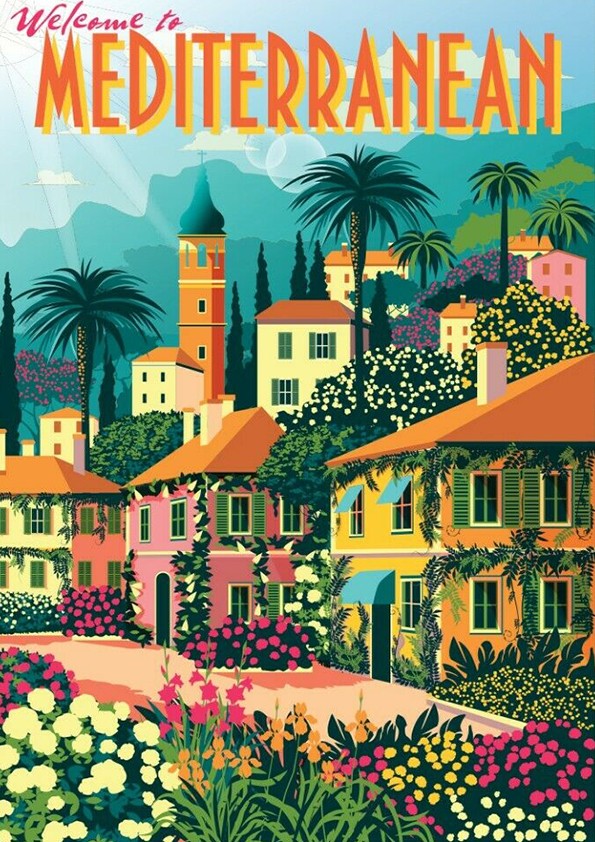
In the last 60 years, the number of tourists in European Mediterranean countries has multiplied exponentially. In these countries, tourism is one of the largest service industries, therefore building a successful, destination brand is of major concern for the economy. It has also, however, societal and ideational consequences. Competing for the same ‘product’ of tourism on a global scale forms a huge part of nation branding. The narrative and imagery of a country’s attractions feeds into the construction and revamping of national identities. In this sense, tourism can become a map to guide our study of discursive, ideational and cultural changes in Mediterranean Europe, particularly in the period from 1945-1989 but also understand the impact of these discourses on cultural identity; for each one of the countries and the history of Southern Europe as a whole. Management and tourism scholars have long investigated the economic and branding implications of this phenomenon, while in recent years, anthropologists and sociologists have discovered the value of the study of tourism. Yet, the historical depth of their approaches is typically quite limited. We are interested in addressing this lacuna in the period from 1945-1990.
Looking at Mediterranean Europe’s tourism offers an invaluable opportunity to write global history from the perspective of small states that developed into popular tourist hubs. What are the advantages of ‘smallness ‘and how did these countries generate a policy with a global reach and international and national consequences? To distil a place’s identity is a complex process that involves a network of multiple stakeholders at local, national, and international level, often with competing interests that attempt to shape a place’s image. The so called ‘holiday makers’ from tour companies, advertising agencies, public authorities and planners, state tourist organisations, graphic designers, national airlines executives and cruise lines produced visual stimuli and textual messaging to familiarise vacations to the mass public. The conference aims to foster an interdisciplinary discussion that, through case studies, mobilises methodological tools from a broad spectrum of fields. These include history of international relations, economic, social, and political history, business history, cold war studies, public diplomacy, visual culture, and communication studies also informed by sociological approaches. Proposals for individual papers or panels may consider, but also go beyond, the following topics and questions, with a focus on Mediterranean Europe:
- What has been the role of the state, local actors, and international players in forming tourism policies. We want to particularly unearth those voices that are pivotal in the construction of an image but get lost in the historical research such as advertising agencies, painters, photographers, marketing executives, private companies.
- The relation between nation state and corporations
- The importance of flag carriers and cruises in forming tourism policies and cementing the country’s brand
- The role of tour operators.
- Cinema and tourist representations; Film-induced tourism
- How did the changing political context influence tourist strategy and politics?
- Each country through tourism promotion created their own visual and textual language with specific national traits but also reflecting globalised trends. What were the campaign’s rhetorical and visual strategies and vernaculars?
- How did tourism marketing/public diplomacy target foreigners, diaspora, or domestic tourists?
- What is the role of modernization and democratisation in each of the state’s development of tourism?
- How did domestic public discourse on tourism impact the country’s ‘nation branding’?
- How were tourists represented?
An abstract of no more than 300 words along with a two-page CV should be submitted to Eirini Karamouzi by no later than 30 January 2023 at e.karamouzi@sheffield.ac.uk.
This conference is co-organised by the University of Sheffield, Centre of Excellence Food, Tourism and Leisure at the American College of Greece and the Institute of Mediterranean Studies.
Scientific Committee:
Mary Ikoniadou (Leeds Beckett University);
Gelina Harlaftis (IMS/FORTH & University of Crete);
Eirini Karamouzi (University of Sheffield/American College of Greece);
Panayis Panagiotopoulos (National and Kapodistrian University of Athens);
Vasilis Vamvakas (Aristotle University of Thessaloniki)
Read more at: https://www.ims.forth.gr/en/news-item/view?id=1441
![Complete Anatomy Training Session [October 7, 2026]](https://hub.uoa.gr/en/wp-content/uploads/2026/10/NKUA_Invite-for-Complete-Anatomy-Training-Session_page-0001-1-1024x604.jpg)
![‘Dialogues for Athens’ Conference Organised by TO VIMA Under the Auspices of the National and Kapodistrian University of Athens and the Municipality of Athens [6-7 October]](https://hub.uoa.gr/en/wp-content/uploads/2026/10/Untitled-Design2-1-1024x576-1.jpg)