

Announcements

Long-Term Outcomes With Zanubrutinib vs Ibrutinib in Symptomatic Waldenström’s Macroglobulinemia

Long-Term Outcomes With Zanubrutinib vs Ibrutinib in Symptomatic Waldenström’s Macroglobulinemia

By Matthew Stenger

Details of the final analysis of the phase III ASPEN trial, which compared zanubrutinib and ibrutinib in symptomatic patients with Waldenström’s macroglobulinemia, were published in the Journal of Clinical Oncology by Meletios A. Dimopoulos, MD, and colleagues.

The study supported the September 2021 approval of zanubrutinib in this setting.

As stated by the investigators, “The phase III ASPEN study demonstrated the comparable efficacy and improved safety of zanubrutinib vs ibrutinib in patients with Waldenström’s macroglobulinemia. Here, we report long-term follow-up outcomes from ASPEN.”

Study Details

In the open-label trial, 201 patients with MYD88-mutant disease (cohort 1) were randomly assigned to receive zanubrutinib at 160 mg twice daily (n = 102) or ibrutinib at 420 mg once daily (n = 99). A total of 28 patients with wild-type MYD88 (cohort 2) received zanubrutinib at 160 mg twice daily. The primary endpoint was the sum of the very good partial response and complete response rates.

Key Findings

At a median follow-up of 44.4 months (range = 0.4–57.3 months), 65.7% of patients on zanubrutinib and 51.5% on ibrutinib in cohort 1 remained on treatment. Rates of very good partial response plus complete response were 36.3% (95% confidence interval [CI] = 27.0%–46.4%) with zanubrutinib vs 25.3% (95% CI = 17.1%–35.0%) with ibrutinib (P = .07). At a median follow-up of 42.9 months (range = 2.3–53.7 months), 35.7% of patients in cohort 2 remained on zanubrutinib; the rate of very good partial response plus complete response was 30.8% (95% CI =14.3%–51.8%).

Among 33 patients on zanubrutinib and 20 patients on ibrutinib in cohort 1 with CXCR4 mutations, very good partial response plus complete response rates were 21.2% (95% CI = 9.0%–38.9%) vs 10.0% (95% CI = 1.2%–31.7%).  

Median progression-free survival and overall survival were not reached in either group in cohort 1. The zanubrutinib group had nonsignificantly fewer progression-free survival events (hazard ratio [HR] = 0.63, 95% CI = 0.36–1.12) and overall survival events (HR = 0.75, 95% CI = 0.36–1.59). In the two groups in cohort 1, progression-free survival at 42 months was 78.3% vs 69.7% and overall survival at 42 months was 87.5% vs 85.2%. In cohort 2, progression-free and overall survival at 42 months were 53.8% and 83.9%, respectively.

In cohort 1, any-grade adverse events of diarrhea (34.7% vs 22.8%), muscle spasms (28.6% vs 11.9%), hypertension (25.5% vs 14.9%), atrial fibrillation/flutter (23.5% vs 7.9%), and pneumonia (18.4% vs 5.0%) were more common in the ibrutinib group; neutropenia (20.4% vs 34.7%) was less common with ibrutinib. Adverse events led to treatment discontinuation in 8.9% of patients in the zanubrutinib group vs 20.4% of the ibrutinib group (P < .05).

The investigators concluded, “Overall, these findings confirm the long-term response quality and tolerability associated with zanubrutinib.”

Dr. Dimopoulos, of the School of Medicine, National and Kapodistrian University of Athens, is the corresponding author for the Journal of Clinical Oncology article.

Disclosure: The study was supported by BeiGene. For full disclosures of the study authors, visit ascopubs.org.The content in this post has not been reviewed by the American Society of Clinical Oncology, Inc. (ASCO®) and does not necessarily reflect the ideas and opinions of ASCO®.

Link: https://ascopost.com/news/august-2023/long-term-outcomes-with-zanubrutinib-vs-ibrutinib-in-symptomatic-waldenstroms-macroglobulinemia/?utm_source=TAP%2DEN%2D080323%2DINTL&utm_medium=email&utm_term=d70aa41f3728827bc510d0f20ff1220a

CardioAthena 2026 Launches ‘Heartworks: The Heart Through Art and Artificial Intelligence’ 3-4 April 2026, Divani Caravel Hotel, Athens

CardioAthena 2026 Launches ‘Heartworks: The Heart Through Art and Artificial Intelligence’ 3-4 April 2026, Divani Caravel Hotel, Athens

The 1st Department of Cardiology at the University of Athens’ School of Medicine, based at Hippocratio General Hospital, is proud to host CardioAthena 2026—the 22nd International Meeting on Cardiovascular Medicine. Alongside the conference, the Organising Committee is inviting students of the National and Kapodistrian University of Athens to take part in ‘Heartworks: The Heart Through Art and […]

LSE Athens Lecture Series Continues with Strong Attendance

LSE Athens Lecture Series Continues with Strong Attendance

The second lecture of the LSE Athens Lecture Series 2025–2026, organised by the London School of Economics and Political Science (LSE) in collaboration with the National and Kapodistrian University of Athens, the Department of Business Administration, and the MSc Financial Technology (FinTech) programme, attracted a lively and engaged audience. The event was held on Friday, […]

Master programme “LL.M. in International and European Legal Studies” by Law School of NKUA (Academic Year 2026-27)

Master programme “LL.M. in International and European Legal Studies” by Law School of NKUA (Academic Year 2026-27)

During the academic year 2026-2027, the Law School of National and Kapodistrian University of Athens will offer an intensive LL.M. Programme in International & European Legal Studies. Description The LL.M. Programme in International and European Legal Studies (IELS) provides students with an advanced and in-depth study in the European and international aspects of private law, […]

META-TOO: A Multidisciplinary Alliance Against Harassment in the Metaverse

META-TOO: A Multidisciplinary Alliance Against Harassment in the Metaverse

META-TOO (A transfer of knowledge and technology for investigating gender-based inappropriate social interactions in the Metaverse) as a WIDERA project aims in strengthening NKUA’s research excellence and management capacity by enhancing staff knowledge and skills, elevating its profile in Metaverse research, and fostering sustainable research and innovation partnerships that expand its collaborative network. META-TOO, as […]

University of Athens Presents Annual Faculty Awards for 2024-2025

University of Athens Presents Annual Faculty Awards for 2024-2025

The National and Kapodistrian University of Athens held its now firmly established and highly symbolic Annual Faculty Awards Ceremony on Wednesday, 25 February 2026, at 18:00, in the filled-to-capacity Great Hall of the University’s Main Building. The awards recognized achievement across three categories: Outstanding Contribution to the University and Society, Outstanding Teaching, and Excellence in […]

Springer Nature Releases Spyridon Vlachopoulos’s Book ‘Political Correctness as Modern Censorship? From Legal to Political Correctness and to the Boundaries of Intellectual Expression’ in Open Access

Springer Nature Releases Spyridon Vlachopoulos’s Book ‘Political Correctness as Modern Censorship? From Legal to Political Correctness and to the Boundaries of Intellectual Expression’ in Open Access

Spyridon Vlachopoulos, Professor and member of the Administration Council at the National and Kapodistrian University of Athens, has recently published his book ‘Political Correctness as Modern Censorship? From Legal to Political Correctness and to the Boundaries of Intellectual Expression’ with Springer Nature on an open access basis. According to the publisher, the book examines the […]

Athens and Belgrade Medical Schools Sign a Memorandum of Understanding in the Presence of Serbia’s Prime Minister, Djuro Macut, and Rector, Gerasimos Siasos

Athens and Belgrade Medical Schools Sign a Memorandum of Understanding in the Presence of Serbia’s Prime Minister, Djuro Macut, and Rector, Gerasimos Siasos

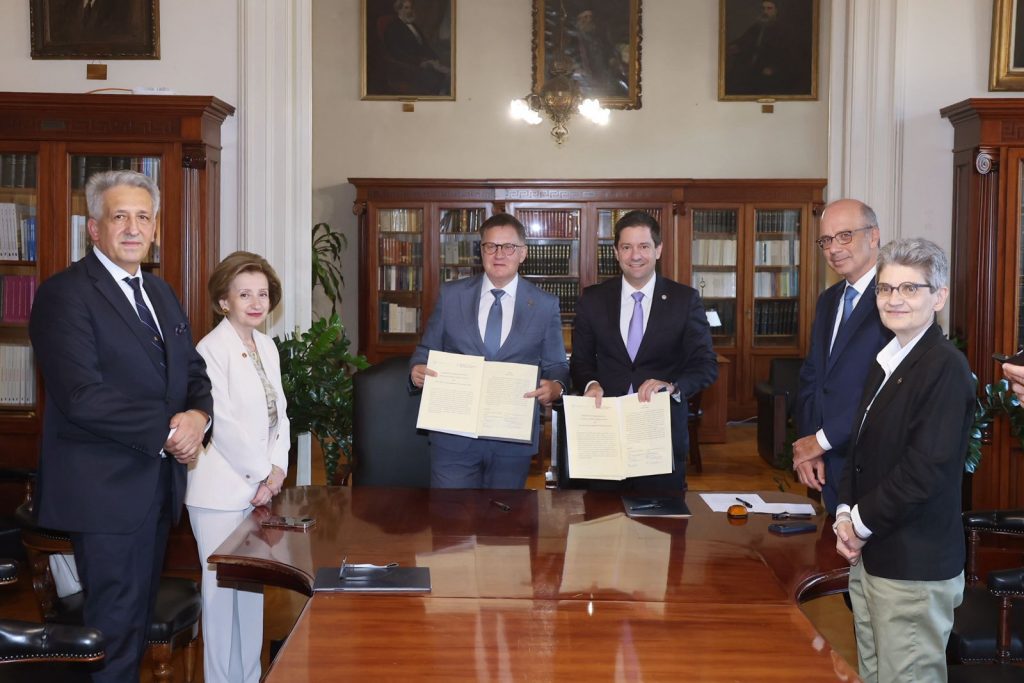
The School of Medicine at the National and Kapodistrian University of Athens and the Faculty of Medicine at the University of Belgrade signed a Memorandum of Understanding (MoU) on Tuesday, 17 February 2026, in a ceremony attended by Serbia’s Prime Minister, Djuro Macut, and the Rector of the University of Athens, Gerasimos Siasos. Professor Macut, […]

University of Athens School of Medicine: Free Obesity Programme Now Available at Clinical Departments through the State ‘Prolamvano’ Initiative

University of Athens School of Medicine: Free Obesity Programme Now Available at Clinical Departments through the State ‘Prolamvano’ Initiative

Obesity is one of the most significant modifiable risk factors for cardiometabolic and cardiovascular disease. The ‘Prolamvano’ programme is a structured public health initiative overseen by the Greek Ministry of Health, clearly showing that prevention works when there is coordinated planning and support from the State and healthcare professionals. Through a unified referral and record-keeping […]

Simulation Laboratory Launches at the University of Athens School of Medicine

Simulation Laboratory Launches at the University of Athens School of Medicine

On 9 February 2026, the University of Athens School of Medicine reached a historic milestone with the launch of its Clinical Simulation Programme, held at the Physiology Laboratory’s Simulation Centre. Part of the Internal Medicine clinical practice curriculum, the programme brings together all eight Departments of Internal Medicine at the School—including the Department of Therapeutics, […]

University of Athens School of Health Sciences Honours Greece’s Alternate Minister of Health, Eirini Agapidaki

University of Athens School of Health Sciences Honours Greece’s Alternate Minister of Health, Eirini Agapidaki

In recognition of her outstanding contributions to public health and society, Greece’s Alternate Minister of Health, Eirini Agapidaki—a graduate of the National and Kapodistrian University of Athens—was presented with an honorary award by the School of Health Sciences. The award highlights her achievements in healthcare and prevention, as well as the lasting social impact of […]

University of Athens

The National and Kapodistrian University of Athens, which was inaugurated on May 3, 1837, was initially housed in a renovated Ottoman building on the northeastern side of the Acropolis. This building has since been restored and now functions as the University Museum. Originally named the "Othonian University," after Otto, the first king of Greece, it consisted of four academic departments and 52 students. As the first university of the newly established Greek state, as well as of the broader Balkan and Mediterranean region, it assumed an important socio-historical role, which was pivotal in the development of specific forms of knowledge and culture within the country.

Stay Connected

Follow hub.uoa.gr on Social Media

closebutton
Skip to content