

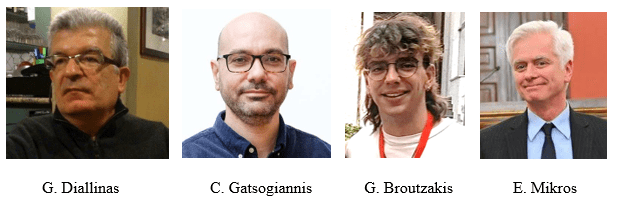
Scientific work of George Diallinas (Professor in the Department of Biology) and Emmanuel Mikros (Professor in the Department of Pharmacology) of the National & Kapodistrian University of Athens (NKUA), in collaboration with Christos Gatsogiannis (Professor at the Institute of Medical Physics and Biophysics and the Center for Soft Nanoscience in Münster), have unraveled unprecedented mechanistic details of a fungal purine transporter using complementary state-of-the-art cryo-electron microscopy (cryo-EM), genetic and functional approaches. The study is now published in the Proceedings of the National Academy of Sciences (DOI: 10.1073/pnas.251358512) providing a major advance in elucidating the transport mechanism of biomedically important “elevator-type” transporters
Transporters are plasma membrane proteins that act as the cell “gatekeepers”, selectively controlling the entry or exit of nutrients, metabolites, signals and drugs. The UapA transporter of the model fungus Aspergillus nidulans represents a very well-studied member of the ubiquitous nucleobase-ascorbate transporter (NAT) family conserved in all domains of life. In bacteria, fungi and plants, NAT transporters mediate the co-transport of purines or pyrimidines. Surprisingly, humans homologues of UapA, known as SVCT1 & 2, are responsible for the transport of vitamin C (ascorbate). Importantly, several Aspergillus species are opportunistic pathogens that can cause severe, life-threatening infections in immunocompromised individuals, underscoring the biomedical importance of understanding NAT, and transporter function in general, in this genus.
Extensive genetic, functional and crystallographic evidence has previously suggested that UapA operates via a specialized “elevator-type” transport mechanism. In this type of mechanism, transporters are composed of a relatively rigid scaffold domain embedded in the membrane, and a mobile transport domain (the “elevator”) that binds the substrate. During transport, the “elevator” moves along the scaffold, carrying the substrate from the outside of the cell into the cytoplasm. This highly dynamic process requires precise coordination with membrane lipids and surrounding water molecules, yet its molecular basis has remained poorly understood due to the lack of high-resolution structural information.
The present work of Professors Diallinas, Mikros and Gatsogiannis led to the capture of new UapA structures in both its substrate-free (“apo”) and substrate-bound states, at an exceptional 2.05 Å resolution, among the highest ever achieved for a eukaryotic membrane transporter by any structural method (Figure 1). The principal actor and first author of this work is George Broutzakis, a PhD student at NKUA. His work, complemented with functional and modeling experiments of Yiannis Pyrris and Ifigeneia Akrani (also PhD students at NKUA), led to unprecedented level of detail and enabled the visualization not only of the UapA transporter architecture, but also of individual water molecules and surrounding membrane lipids, revealing how they regulate substrate binding, affinity, and the transport cycle.

Figure 1. cryo-EM structure of the UapA dimer as viewed from the side.
One protomer is colored by domain; core domain: blue; scaffold domain: pink; N-terminal tail: green. Densities assigned to lipid or DDMs are colored in orange.
One of the most striking findings concerns the protein’s N-terminal tail, previously thought to be intrinsically disordered. The new structures demonstrate that this region fulfills a dual function: it ensures proper folding and trafficking of the transporter to the cell surface, and it also acts as a regulatory element that caps the elevator domain and directly participates in the conformational changes required for transport.
Beyond its fundamental biological significance, the present work also carries strong biomedical relevance as transporters such as UapA are exploited by various compounds, including antifungal agents, to enter fungal cells. Thus, a deeper understanding of transporter structure and function may contribute to the development of new therapeutic strategies against fungal infections caused by pathogenic Aspergillus species, which pose a continuously emerging risk to immunocompromised patients.
For more Information please contact:
Prof. George Diallinas
diallina@biol.uoa.gr
+306974799929


![Complete Anatomy Training Session [October 7, 2026]](https://hub.uoa.gr/en/wp-content/uploads/2026/10/NKUA_Invite-for-Complete-Anatomy-Training-Session_page-0001-1-1024x604.jpg)

![‘Dialogues for Athens’ Conference Organised by TO VIMA Under the Auspices of the National and Kapodistrian University of Athens and the Municipality of Athens [6-7 October]](https://hub.uoa.gr/en/wp-content/uploads/2026/10/Untitled-Design2-1-1024x576-1.jpg)