

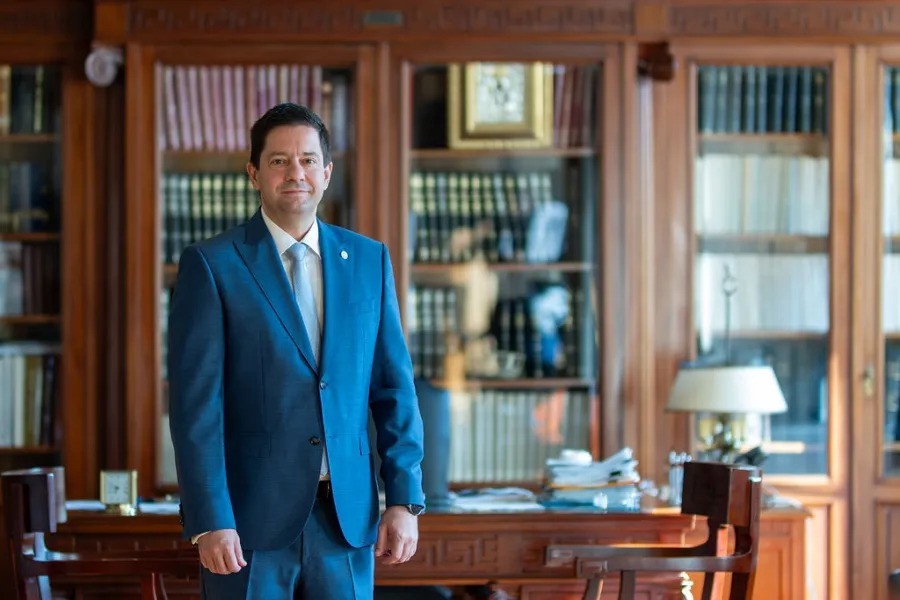
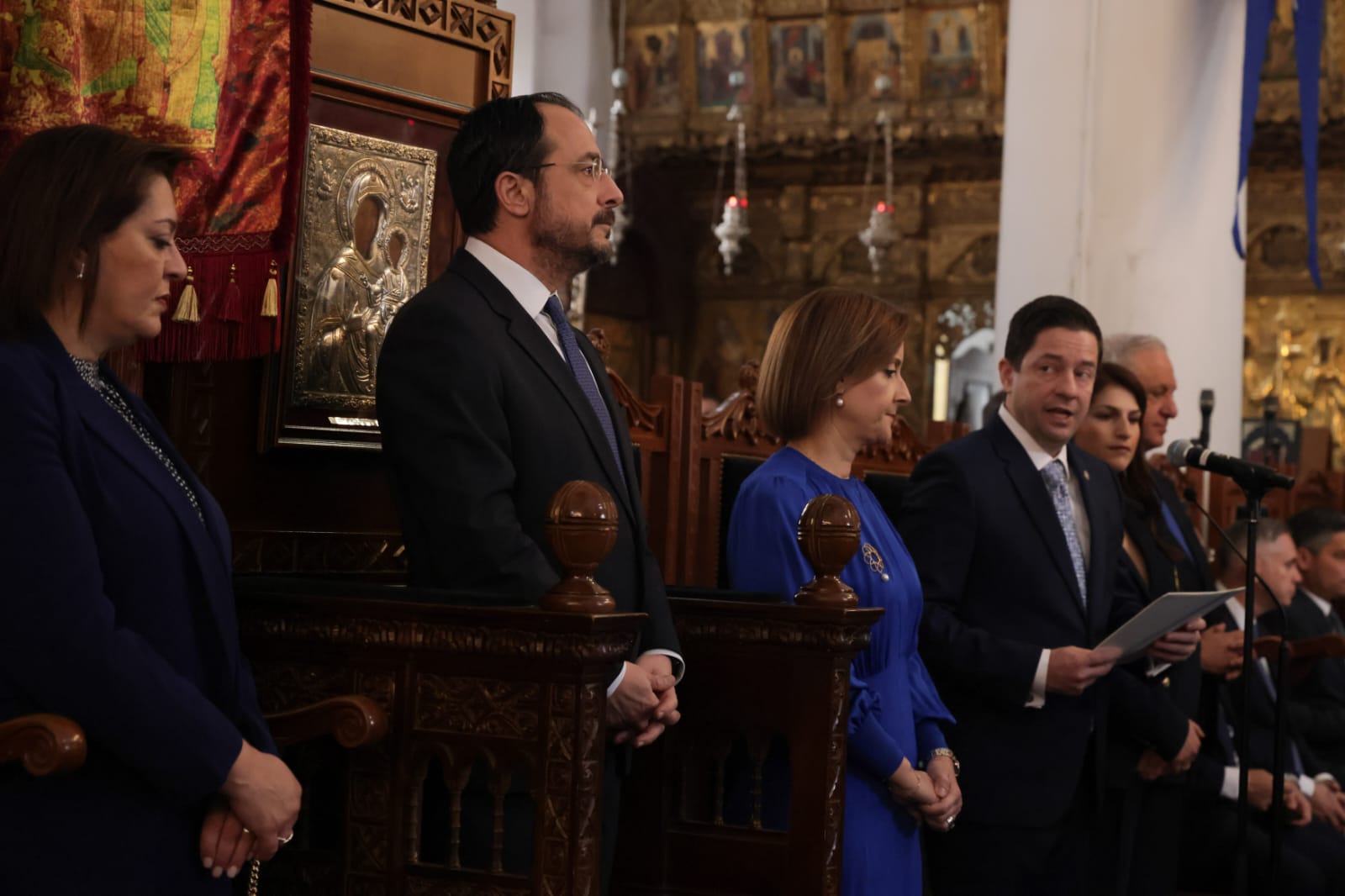
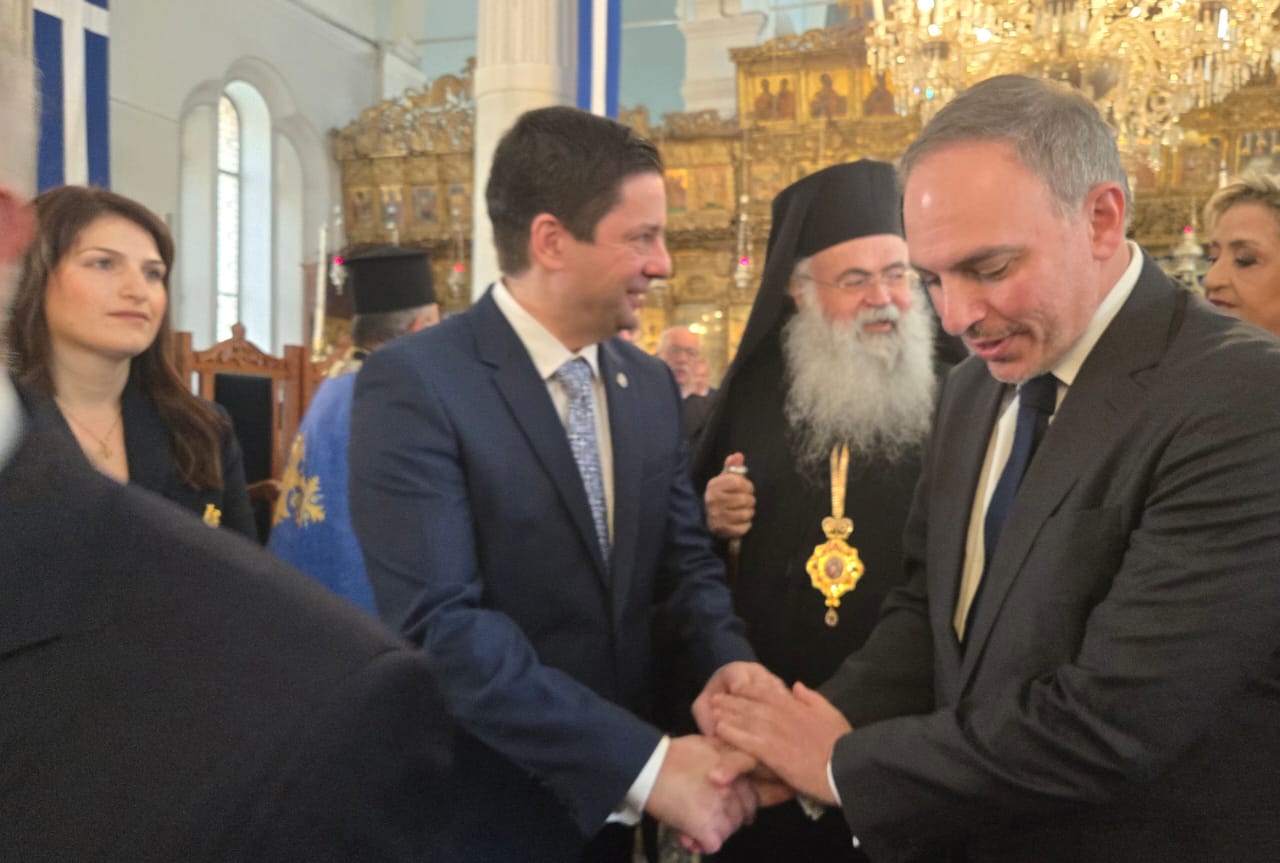
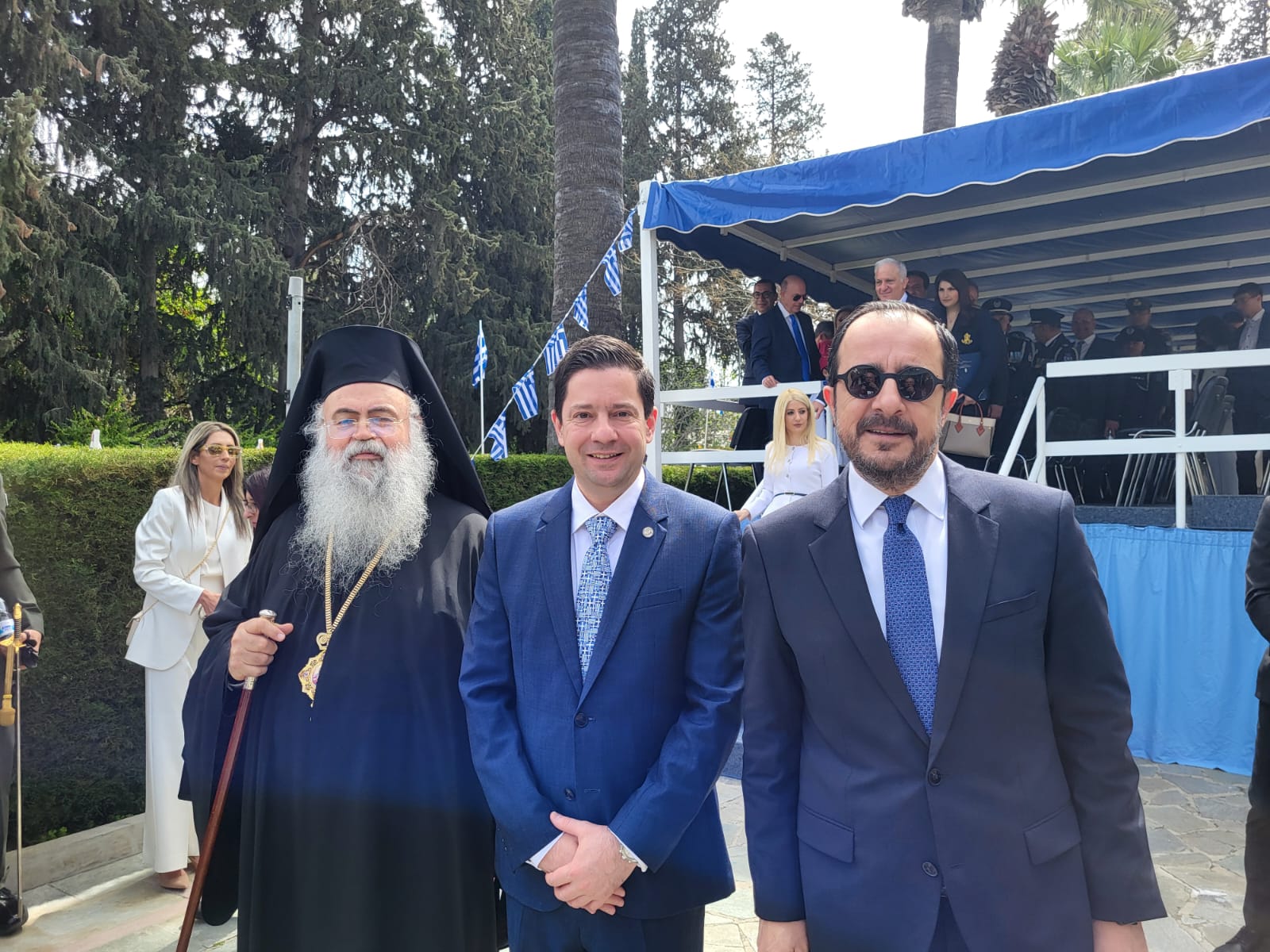
A service of Doxology was held today at 10:00 a.m. at the Faneromeni Church in Nicosia by His Beatitude, the Archbishop of Cyprus Mr Georgios, in the presence of the President of the Republic of Cyprus, Mr Nikos Christodoulides, and the Rector of the National and Kapodistrian University of Athens, Greece, Professor Gerasimos Siasos, who also delivered the panegyric on March 25, 1821.
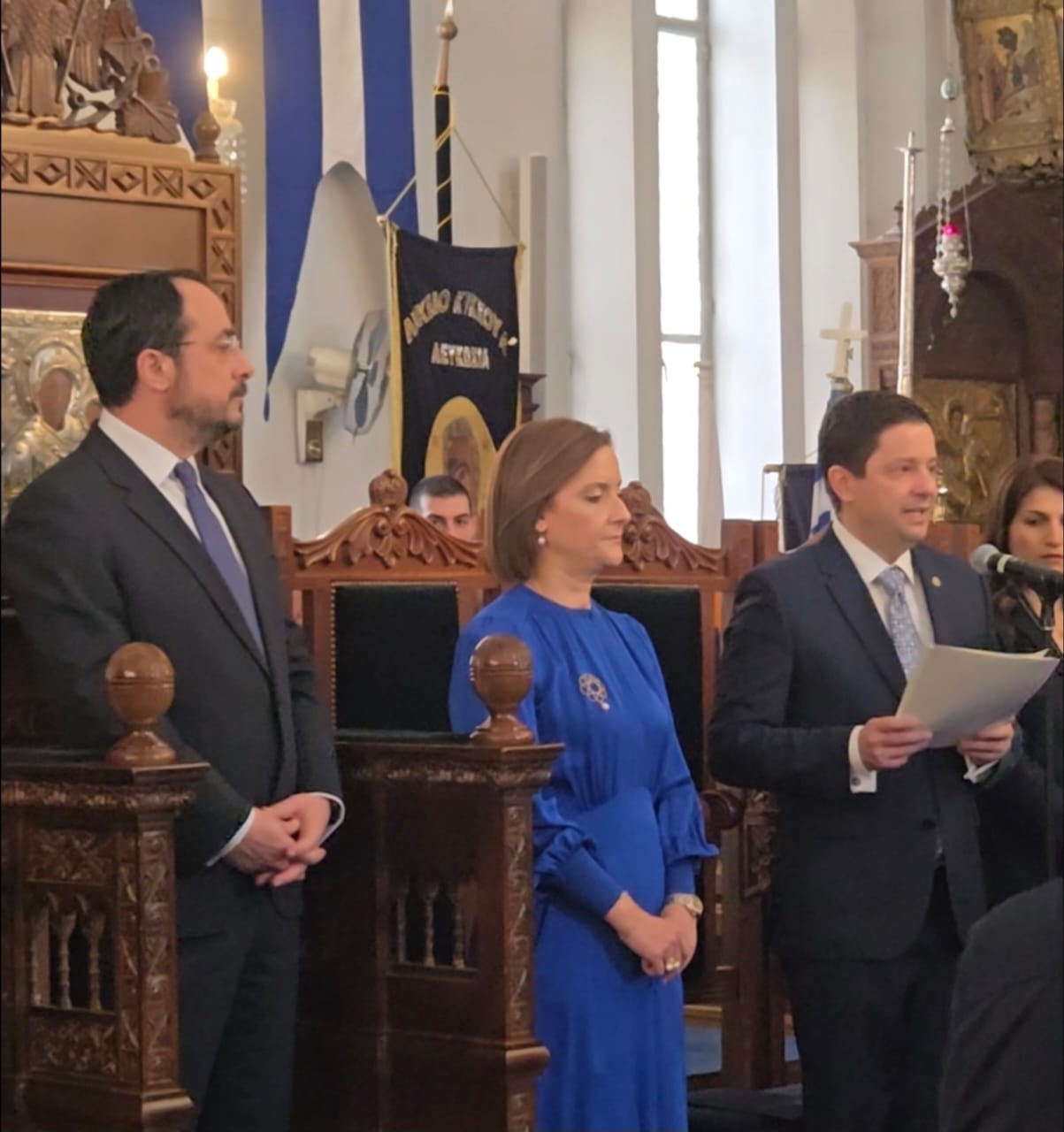
In attendance, among others, were H.E. the President of the House of Representatives of Cyprus, Ms Annita Demetriou, H.E. the Ambassador of the Hellenic Republic to the Republic of Cyprus, Mr Ioannis Papameletiou, as well as the rest of the political and military authorities of the island.
In his speech, the Rector of the University of Athens, Professor Gerasimos Siasos, said, among other things, the following: ‘Today, March 25, 2025, in this historic Holy Church of Panagia Faneromeni in Nicosia, I feel a strong sense of duty as Rector of the National and Kapodistrian University of Athens, our entire nation’s oldest and largest University, to deliver the “appropriate speech” at this year’s celebration of the Greek War of Independence and express my gratitude to Cypriot Hellenism for their invaluable dynamic presence in our National Struggles for Liberty.
Honouring with words one’s ancestors and the deeds that shaped the course of our nation is never an easy task, even more so when it comes to a struggle as great as the Revolution of 1821; a struggle that seemed practically impossible to Europeans at the time and profoundly changed how the nations viewed their right to freedom and self-determination; a struggle that dared to directly challenge the political forces of the era and cost the lives of a large part of the population in the areas ultimately liberated.
Through countless sacrifices and rivers of blood, that heroic struggle yielded its first results: freedom returned, albeit to a limited part of the Greek lands. The Greek nation, then at risk of disappearing altogether, was saved within an organized state, aiming to keep its tradition alive, preserve its culture, and restore its territorial integrity. At the same time, it lit the flame of liberation in the hearts of other nations, which would eventually limit the reach of Ottoman power over the Balkan Peninsula.
The most significant contribution of the Greek Revolution to the political history of Europe was none other than the crack it created in the doctrine of the Holy Alliance. Through the struggle of the Greeks, the principle of freedom and self-determination—the cornerstone of liberalism, which was to dominate Europe in the decades to come—began to gain ground. In this sense, the Revolution of 1821 was not just a defining moment in Greek history but also a watershed event for Europe, which started moving away from absolutism in favour of the values of political freedom.
Still extant is a letter sent by Alexandros Ypsilantis to Kyprianos of Cyprus dated 8th October 1820. Antonios Pelopidas, a member of the Filiki Eteria or the “Society of Friends”, delivered the letter to the Archbishop. In his message written in the characteristic cryptic language of the Society, Ypsilantis called on Kyprianos to send his help without delay, as “the return to School was close”.
At the National Historical Museum in Athens, a war banner is on permanent display bearing the inscription “GREEK FLAG – CYPRUS HOMELAND” [ΣΗΜΕΑ ΕΛΗΝΗΚΙ – ΠΑΤΡΗΣ ΚΗΠΡΟΥ]. This flag likely belonged to a group of Cypriot fighters who took part in the military engagements.
In 1827, Ioannis Kapodistrias stressed to a delegate of the English Foreign Secretary that the boundaries of the soon-to-be-established Greek state took shape through the “blood shed in massacres in Kydonies, Cyprus, Chios, Crete, Psara, and Mesolongi”. And, in October 1828, in a memorandum to the Ambassadors of the Great Powers during their Conference on Poros, he added that the history and monuments of antiquity protest that “Rhodes, Cyprus, and so many other islands are parts of Greece”. The Cypriots, for their part, wrote to Ioannis Kapodistrias, requesting his assistance in liberating Cyprus and incorporating it into the Greek state.
The vision of freedom and Union with mother Greece was still alive.
The history of the Greek state is inextricably linked with the National and Kapodistrian University of Athens. For one hundred years after the Revolution of 1821 it was the only University in the country. The notion of contemporary science and scientific fields appeared for the first time in our country at the University of Athens. Our University laid the groundwork for the organization of the Greek state, along with the development and staffing of all its Institutions, including schools, hospitals, the public service, and the justice system. The University of Athens was founded as the newly independent State’s intellectual leader and played a pivotal role in building our country and shaping our national identity. That is why Theodoros Kolokotronis referred to it as “the national house of Greece”.
Since its foundation in 1837, the University of Athens has maintained deep and enduring ties with Cyprus, thanks, first and foremost, to the presence of hundreds of thousands of Cypriot students in its lecture halls for over two centuries. As a matter of fact, the University of Athens was the first academic Institution in South-Eastern Europe and, for one hundred years, served as the sole pillar of Higher Education for Greeks worldwide.
The time spent by Cypriot students at the University of Athens familiarized them with the ideals of classical Greek education, keeping them firmly close to the Greek Orthodox tradition and the Greek language. Thousands of Cypriot graduates—women and men—returned to the island and made a decisive contribution to its intellectual and economic growth. It is common knowledge, after all, that many key figures of modern and contemporary Cyprus went to the National and Kapodistrian University of Athens.
Our University’s support during the struggles of Cypriot Hellenism was unwavering, multifaceted, and active. Let us not forget the mass demonstrations of the 1955-1959 period, accompanied by fervent protests outside the British Embassy in Athens against the hangings of Cypriot fighters; and that in 1953, Archbishop Makarios III administered the oath of allegiance to the leaders of EOKA, the National Organization of Cypriot Fighters, at the house of Gerasimos Konidaris, the then Dean of the School of Theology of the University of Athens.
Likewise, let us recall the resounding resolution issued in 1974 by the Senate of the University of Athens to all Universities worldwide denouncing the Turkish atrocities and expressing the Institution’s unwavering support for Cyprus. In response, Archbishop Makarios, a graduate of the University of Athens, sent a heartfelt letter to the University, extending his deep gratitude to an Institution that “significantly strengthens the struggle of the Cypriots and provides their just cause with valuable moral capital”.
And in later years, following the brutal Turkish invasion and the ongoing illegal and forceful occupation of ancient cradles of Greek civilization, the National and Kapodistrian University of Athens made a concerted effort to creatively support the deeply afflicted Hellenism of the island. This programme, comprising countless actions and events, continues to this day, enriched and adapted to the evolving circumstances. Our University undertook several significant initiatives to champion our national cause, including issuing resolutions and launching appeals to international organizations, organizing seminars, symposia, and academic conferences, and hosting innumerable annual commemorations in Athens and beyond. We also introduced modules on Cyprus in undergraduate and postgraduate programmes of study.
And we continue with the primary goals of broadening our self-awareness as the two components of Hellenism and strengthening our national unity.
The opening of a branch campus of the National and Kapodistrian University of Athens in Cyprus is a project of national importance and, once implemented, will mark a milestone in Higher Education and academic cooperation between Greece and Cyprus. The operation of this branch will further strengthen the existing strong national ties, offer fresh opportunities for our students and academics, and serve as a beacon of education, scientific research, and innovation in Cyprus. Our main purpose is for the intellectual unification of Cyprus with Greece to be realized through our National University.
March 25th, 1821, is the most significant day in the history of Hellenism since it marks the beginning of our national rebirth.
As it was then, so it is now: the struggle continues with faith, perseverance, and an awareness of our historic mission. Just as the uprising of 1821 united the Greeks of the 19th century, so too should the memory of this Revolution, which led to the formation of the modern Greek State, reawaken and reunite us.
It was exactly this unity that Aristotle pointed to in his Politics twenty-three centuries ago as the catalyst for peace, progress, and amazing feats:
“The Greek race, which, due to its geographical position, lies precisely between the Europeans and the Asians, has the virtues of both, for it combines, at once, high spirit with acute intellect. For this very reason, it lives freely and governs itself in the best possible way, and, if it had a unified political system, it could dominate over all other nations”.
Let us pay attention to what Aristotle tells us. The Greeks, he says, are extremely intelligent, have courage, and a free political system. But unity is sometimes lacking. We are not always united, and this is a recipe for disaster. Unity makes the Greeks powerful, and this unity must be at the heart of every national endeavour’.
![Complete Anatomy Training Session [October 7, 2026]](https://hub.uoa.gr/en/wp-content/uploads/2026/10/NKUA_Invite-for-Complete-Anatomy-Training-Session_page-0001-1-1024x604.jpg)


![‘Dialogues for Athens’ Conference Organised by TO VIMA Under the Auspices of the National and Kapodistrian University of Athens and the Municipality of Athens [6-7 October]](https://hub.uoa.gr/en/wp-content/uploads/2026/10/Untitled-Design2-1-1024x576-1.jpg)