
In a feature published on Wednesday, 20 May 2026, the Greek daily newspaper Ta Nea highlights the Accessibility Unit of the National and Kapodistrian University of Athens as one of the country’s leading examples of inclusive higher education.
The feature follows Ta Nea’s visit to the Unit and examines how it has become a model for inclusive practice across Greek higher education.
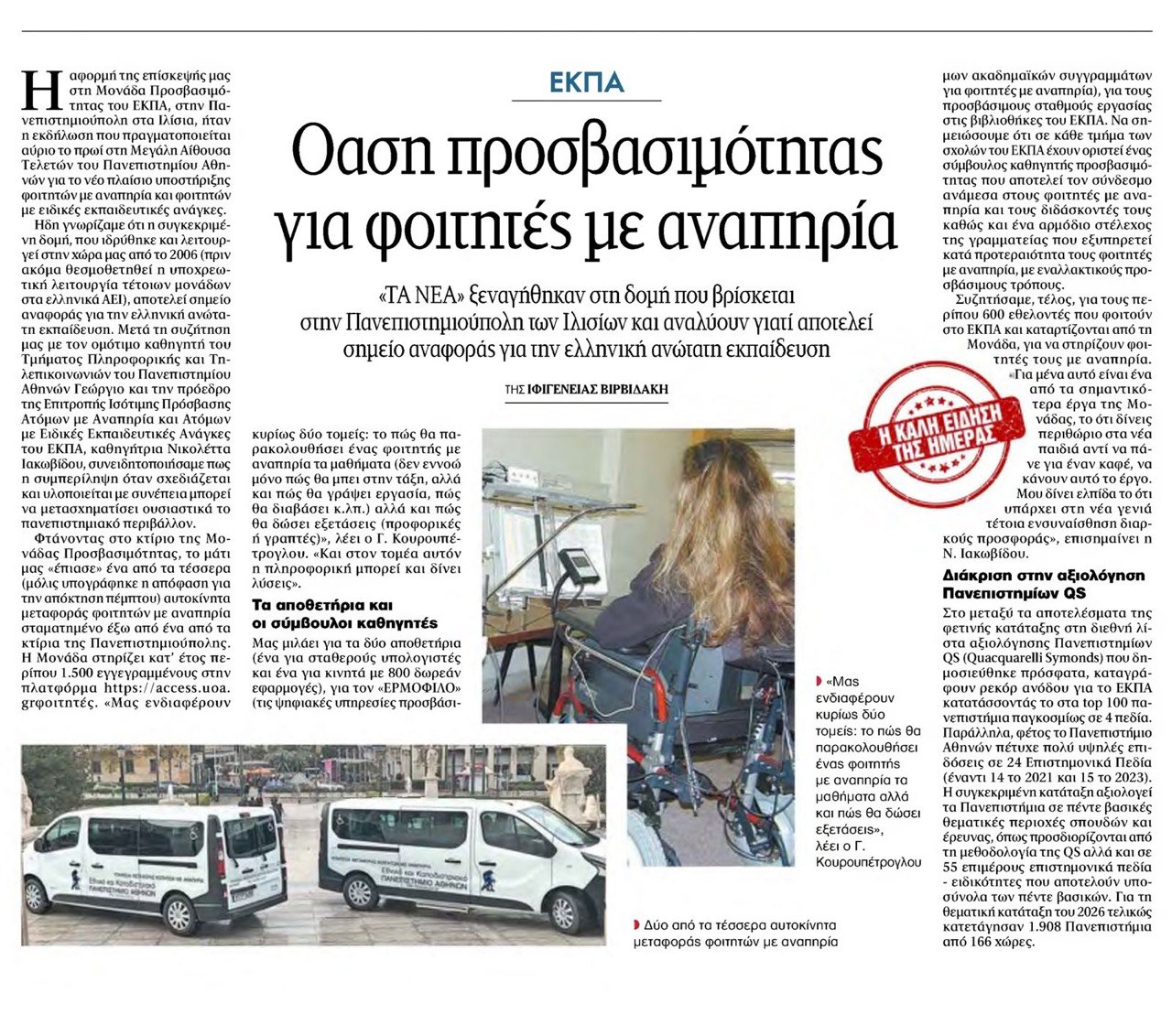
Read the full article in Greek on Ta Nea’s website
Ahead of an event at the University’s Great Hall on 21 May 2026 focusing on the new support framework for students with disabilities and special educational needs, Ta Nea visited the University’s Accessibility Unit at the Ilisia campus.
The Unit has been operating since 2006 – well before similar structures became mandatory across Greek universities – and is widely recognised as a leading model for supporting students with disabilities in Greek higher education. During the visit, conversations with Emeritus Professor Georgios Kouroupetroglou of the Department of Informatics and Telecommunications and Professor Nikoletta Iakovidou, Chair of the Accessibility Committee at the University of Athens, made it clear that sustained investment in inclusion can reshape the university experience for students.
The newspaper also reported on one of the four vehicles used to transport students with disabilities, as the University has already approved the purchase of another. The Unit currently supports around 1,500 registered students each year through its platform at https://access.uoa.gr. ‘We are primarily concerned with two areas’, said Professor Kouroupetroglou. ‘First, how a student with a disability interacts with their studies – not just by attending lectures, but also by completing assignments, accessing reading materials, and so on – and second, how they take exams, whether oral or written. Digital tools have opened up practical ways to remove barriers to learning and assessment.’
Technology and Accessibility Support
Professor Kouroupetroglou also spoke about the University’s digital repositories for desktop computers and mobile devices – giving students access to around 800 free software tools – as well as ‘Ermofilos’, the digital service providing accessible textbooks for students with disabilities. He further referred to the accessible workstations in the University’s libraries. Across the University, each academic unit designates an Accessibility Adviser to serve as a link between students with disabilities and their teaching staff. In addition, administrative staff are assigned to provide priority support to students with disabilities, ensuring assistance is delivered through accessible and alternative communication channels.
The visit also emphasised the approximately 600 volunteers enrolled at the University of Athens, who receive training through the Accessibility Unit to support students with disabilities. ‘For me, this is one of the most important aspects of the Unit’s work’, said Professor Iakovidou. ‘It gives young people the opportunity, instead of going out for a coffee, to engage in something meaningful. It gives me hope that this sense of sustained solidarity and empathy exists among the younger generation.’
Strong Performance in the QS World University Rankings by Subject
Meanwhile, the latest QS World University Rankings by Subject recorded an excellent year for the National and Kapodistrian University of Athens, placing it among the world’s top 100 universities in four subject areas. At the same time, the University achieved very strong performance across 24 narrow subjects this year, compared with 14 in 2021 and 15 in 2023. This ranking evaluates universities across five broad subject areas, as defined in the QS methodology. It also covers 55 narrow subjects, representing specialised disciplines within these five main fields. For the 2026 subject rankings, a total of 1,908 universities from 166 countries were evaluated.
![Complete Anatomy Training Session [October 7, 2026]](https://hub.uoa.gr/en/wp-content/uploads/2026/10/NKUA_Invite-for-Complete-Anatomy-Training-Session_page-0001-1-1024x604.jpg)

![‘Dialogues for Athens’ Conference Organised by TO VIMA Under the Auspices of the National and Kapodistrian University of Athens and the Municipality of Athens [6-7 October]](https://hub.uoa.gr/en/wp-content/uploads/2026/10/Untitled-Design2-1-1024x576-1.jpg)