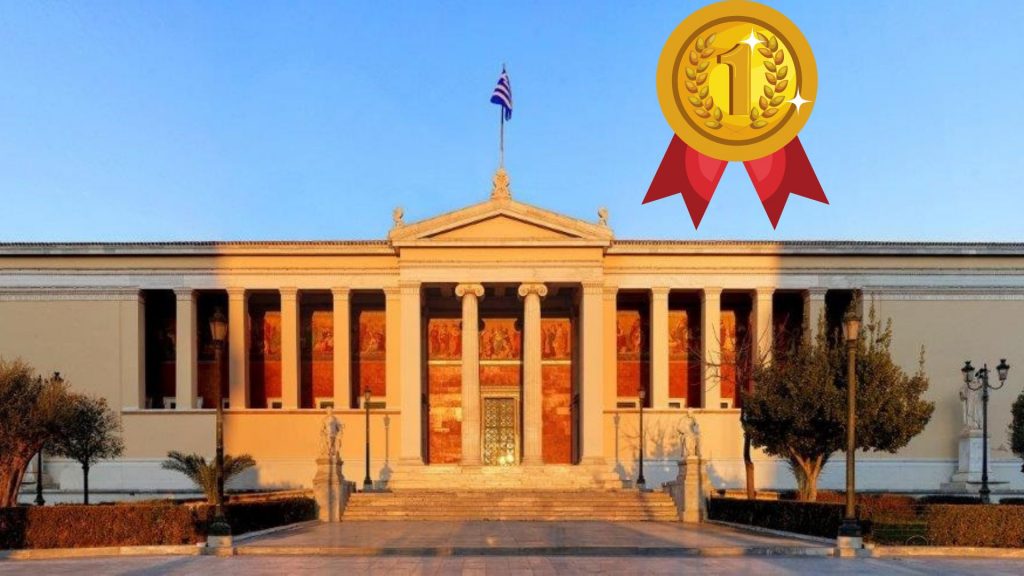
![NKUA will host the Springer 2nd International Conference on Frontiers of Artificial Intelligence, Ethics, and Multidisciplinary Applications – Call for papers [01-02/10/2024]](https://hub.uoa.gr/en/wp-content/uploads/2024/07/nkua-central-building-1024x681.jpg)
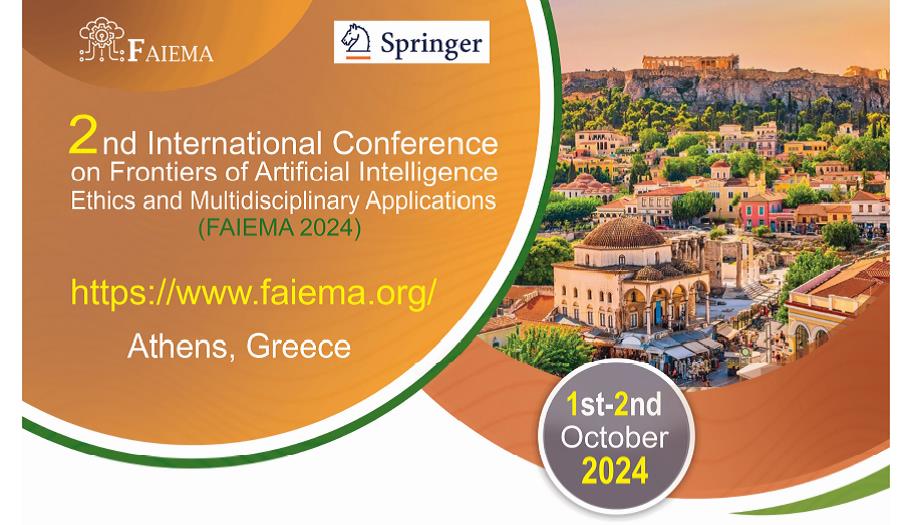
The Robotics, Automatic Control and Cyber-Physical Systems Laboratory of the National and Kapodistrian Univesity of Athens will host the Springer 2nd International Conference on Frontiers of Artificial Intelligence, Ethics, and Multidisciplinary Applications (FAIEMA 2024). The conference will take place on 1st -2nd October 2024 at the “Alkis Argyriadis” and “Ioannis Drakopoulos” amphitheatres of NKUA.
The conference is organized by NKUA in collaboration with the University of Stavanger (Norway), the Universität Klagenfurt (Austria), the Simula Metropolitan Center for Digital Engineering (Norway), the Western Norway University of Applied Sciences (Norway), National Technical University of Athens (Greece), Simplifai AS (Norway), Amazon Web Services and Public Cloud Group. Also, a faculty members of the University of West Attica participates in the organization committee. The Technical Program Committee comprises faculty members and researchers originated from more than 20 universities/research centers.
FAIEMA 2024 is a response to the growing need among those working on artificial intelligence in academia, business and industry, and the public sector to explore opportunities in this constantly evolving field.
Topics of Interest Include, but are not Limited to:
- Advances in AI – Generative AI, NLP, Vision, Voice, and Self-taught AI Systems
- Soft Computing and Evolutionary Computing;
- NeuroEvolutionary Techniques;
- Innovations in AI methods, techniques, and algorithms;
- Explainable AI;
- AI and Robotics;
- AI and Automatic Control;
- AI and Cloud;
- AI and IoT;
- Intelligent Engineering Systems, Expert Systems;
- Knowledge-Based Systems;
- Ethical use of AI;
- Guiding the Development of Human-Friendly AI;
- Exploring human well-being through AI;
- AI for competitive advantage;
- AI applications – Health, Energy, Manufacturing, Education, Digital Humanities, and Others;
- AI applications for business, governance, education, economic planning, and legal solutions.
Accepted papers will be published as an edited book volume with the Springer book series: Frontiers of Artificial Intelligence, Ethics and Multidisciplinary Applications.
Steering Committee:
- Dr. Antorweep Chakravorty; Professor, University of Stavanger, Norway (Chair)
- Dr. Michael Riegler; Chief Scientist, Simula Metropolitan Center for Digital Engineering, Norway
- Dr. Fotis N. Koumboulis, Professor, National and Kapodistrian University of Athens
- Dr. Stefanos Kollias, Professor Εmeritus, National Technical University of Athens, GRNET – National Infrastructures for Research and Technology, Greece
Organization Committee:
General Chair:
- Dr. Maria Tzamtzi; Professor, National and Kapodistrian University of Athens, Greece
Local Chair:
- Dr. Stefanos Kollias, Professor Εmeritus, National Technical University of Athens, GRNET – National Infrastructures for Research and Technology, Greece
Program Committee Co-Chair:
- Dr. Klaus Schöffmann; Associate Professor, Klagenfurt University, Austria
- Dr. Paul Sotiriadis; Professor, National Technical University of Athens, Greece
Research Track Co-Chair:
- Dr. Nikolaos Kouvakas; Associate Professor, National and Kapodistrian University of Athens, Greece
- Dr. Jayachander Surbiryala; Engineer, University of Stavanger, Norway
Ph.D. Symposium Chair:
- Dr. George Chamilothoris, Professor, University of West Attica, Greece
Industry Track Chair:
- Dr. Bikash Agrawal, Data Scientist, Simplifai AS, Norway
Publicity Chair:
- Dr. Michael Skarpetis; Associate Professor, National and Kapodistrian University of Athens, Greece
Proceeding Editors:
- Dr. Mina Farmanbar; Associate Professor, University of Stavanger, Norway (Chair)
- Dr. Maria Tzamtzi; Professor, National and Kapodistrian University of Athens, Greece
- Dr. Klaus Schöffmann; Associate Professor, Klagenfurt University, Austria
- Dr. Nikolaos Kouvakas; Associate Professor, National and Kapodistrian University of Athens, Greece
- Dr. Ajit Kumar Verma; Professor, Western Norway University of Applied Sciences, Norway
See more about submitting papers at: https://www.faiema.org/ or in the attached file: