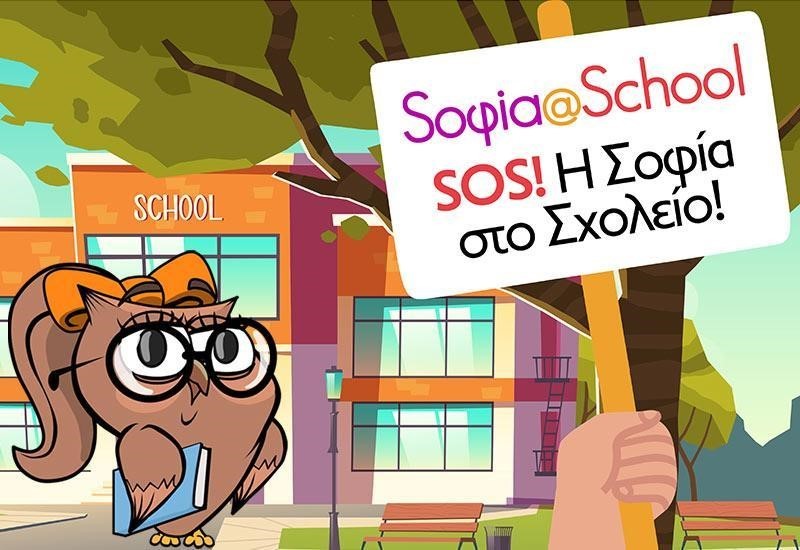
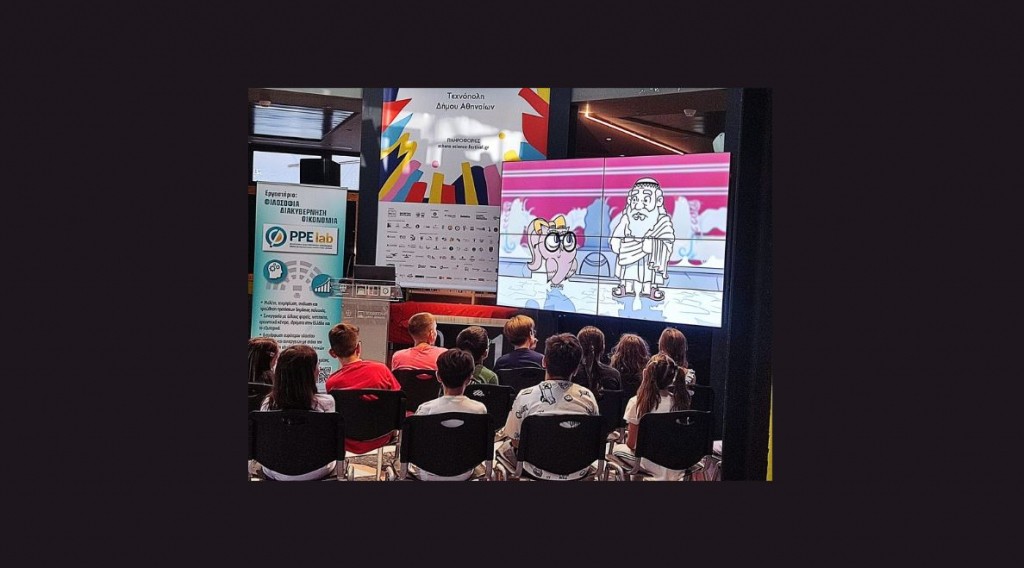
I was pleasantly surprised to hear from my daughter’s school that a new philosophy program for children, “Sophia at School”, was being introduced in the 4th grade. We, along with other parents, were excited about the program, especially when we noticed that after it began, the children were actively discussing various simple logical reasoning exercises and paradoxes, such as, “The owl is a bird and flies. The drone flies, so does that mean the drone is a bird?” They were even correcting each other!
When I asked my daughter what stood out about this lesson, she said it was funny. “What do you mean?” I asked. “Well,” she said, “Sophia the owl is funny. You should check her out on YouTube!” Then, she opened a browser, showed me a video on the learning platform at www.mysofia.gr and added: “In one lesson, for example, we used logical thinking to figure out what the cat broke in a room. I loved it!”
This experience made me eager to learn more about the creator of this engaging teaching method that gets children excited about logical reasoning—especially in a time when, unfortunately, logic and common sense seem to be lacking in both young and old. I truly hope that logic will continue to play an essential role in school, as it is a valuable skill for both academic and daily life.
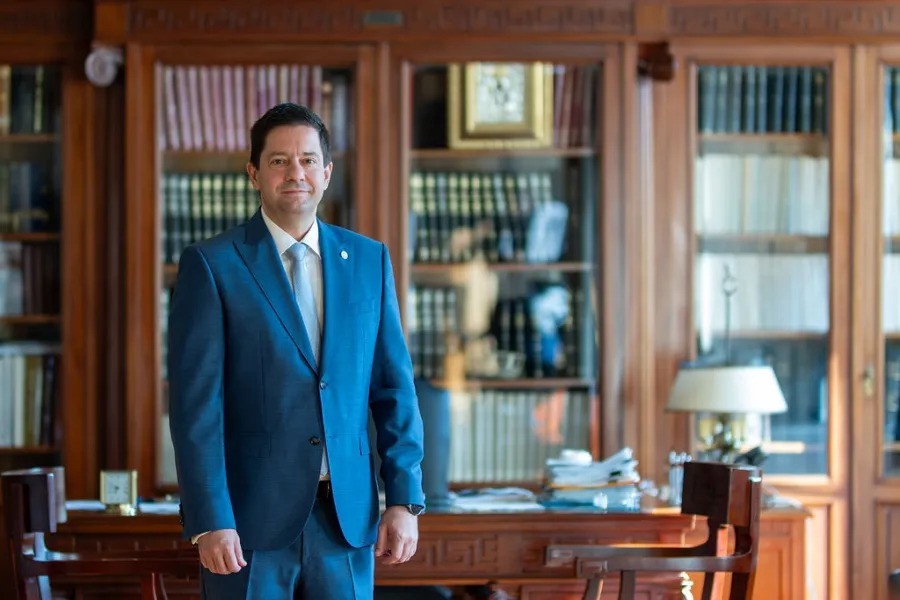
George N. Politis is Professor of Social Philosophy at the National and Kapodistrian University of Athens and Director of the Philosophy, Politics, Economics Laboratory, www.ppelab.gr
What is the “Sofia@School” program?
It is a standardized and certified method for teaching philosophy to Primary school students. It combines digital technology and innovative means: original animations, gamification, digital game-based learning, and processes of step-by-step familiarization with complex philosophical concepts of logic and ethics. These means encourage the active participation of students. They capture their attention while stimulating mechanisms for deeper learning and understanding. “Sofia@School” teaches children to think, to question creatively, and to evaluate beliefs and values critically.
How was this idea born?
The fundamental problem in Greek education, as reflected in international surveys, is the lack of critical and creative thinking. Children do not know -and above all do not learn- to think rationally and coherently. As a result of this weakness, they are unable to recognize and assimilate knowledge. As a result, they do not develop intellectually, cognitively, and emotionally as much as they could. The new generation is exposed to a flood of information without the ability to evaluate the content. “Sofia@School” addresses this problem.
What would you answer if you were told that philosophy is very difficult and demanding and in a way “unsuitable for young children”?
Many people think that philosophers are lonely individuals who talk in incomprehensible riddles. There are such people. But they express a small trend, not the whole of philosophy. As we know, as far back as Socrates’ time, philosophers have been living in the world, studying real problems of real people. Philosophy does not complicate things: It cleans up the garbage that hides the path to knowledge.
Do you teach children philosophy?
We don’t teach the history of philosophy -what this or that great thinker said. We use philosophy as a problem-solving method, we teach children to think more clearly. Highlighting the differences between hypothesis and proof, thesis and argument, cultivates young people’s resilience to deception and fake news.
When did the planning and implementation of “Sofia@School” start?
It was conceived in 2019 as a research proposal of the PPE Lab of the University of Athens. It was submitted to the Hellenic Foundation for Research and Innovation and was approved, ranking 9th out of 340 proposals. Through the Project, the teaching of Philosophy in Primary Education was implemented for the first time in Greece on an extended scale (Private and Public schools in Athens and the Periphery). From 2023 it is offered as an integrated, innovative, digital learning tool. It combines face-to-face and distance modern and asynchronous education (digital platform and software, www.mysofia.gr). It creates and orchestrates digital communities of students, parents, schools, teachers and researchers of the University of Athens.
How is the course taught?
Through a specially designed Train the Trainers training seminar, held at the University of Athens, “Sofia@School” trains and certifies the teachers of the schools that integrate it into their curriculum. In 2024, Athens College, Psychiko College, Geitonas School and Neue Schule Athens participated in the program. Teachers are taught, step by step, each of the eleven modular courses that make up the Program, and receive all the digital and physical material. They thus become mediators of the method to their students.
What is the impact of the method?
The program has been piloted and evaluated, and notable changes have been recorded. In terms of quantitative outcomes, the Program yielded a statistically significant improvement in the level of critical thinking among children, with an increase of 16.44%. At the qualitative level, the program has been observed to facilitate an improvement in the capacity to construct logical and well-founded arguments, to make sound and accurate judgements, and to comprehend the necessity of established regulations as a foundation for individual autonomy. In the global environment where children are bombarded with information that teachers find challenging to transform into knowledge, “Sofia@School” does not introduce new information. Conversely, it enables children to adopt a mode of thinking that allows them to distinguish between authoritative knowledge and subjective opinion.
How do you plan to develop “Sofia@School”?
In order to facilitate the development of “Sofia@School”, we established LogoStart, an innovative spin-off company of the National and Kapodistrian University of Athens, aiming to introduce philosophy into primary education through the use of advanced digital learning tools. LogoStart is the fourth spin-off of NKUA and the only one in Greece that originates from the field of Philosophy. It is included in Elevate Greece, the National Register of Start-ups. It is not uncommon for start-ups to remain at the “idea” stage. In contrast, rapidly evolving, “Sofia at School” has transformed into a comprehensive educational product, successfully utilized by leading educational institutions across Greece. Following the successful launch of our method in Greece, we are now seeking investment to enhance its functionality based on Artificial Intelligence and to expand its global reach. Ιn particular, we are currently engaged in discussions with investors with a view to facilitating the international expansion of LogoStart, firstly, with regard to the English-speaking version of our program.
Does the program “Sofia@School” have a limited scope, being offered exclusively to private schools?
No, that is not the case! However, private schools are more flexible in this regard. We have received numerous applications from public school teachers and principals. We are also considering sponsoring Greek-speaking schools abroad, particularly in areas where there is a minority Greek population. Our objective is to make “Sofia@School” more widely available and to integrate it into the standard Primary School program. In order to achieve this goal, our company submitted a detailed proposal to the Greek Ministry of Education in June. This proposal outlines a proposed trial implementation of the “Sofia@School” program in the thirty-eight Μodel and Experimental Primary Schools.
What you would like to achieve with LogoStart?
Our vision is to globally introduce the philosophical mindset to primary school students, equipping the new generation with essential skills such as critical thinking, sound judgment, the ability to formulate valid arguments, the recognition of ethical principles, and a deep understanding of justice.