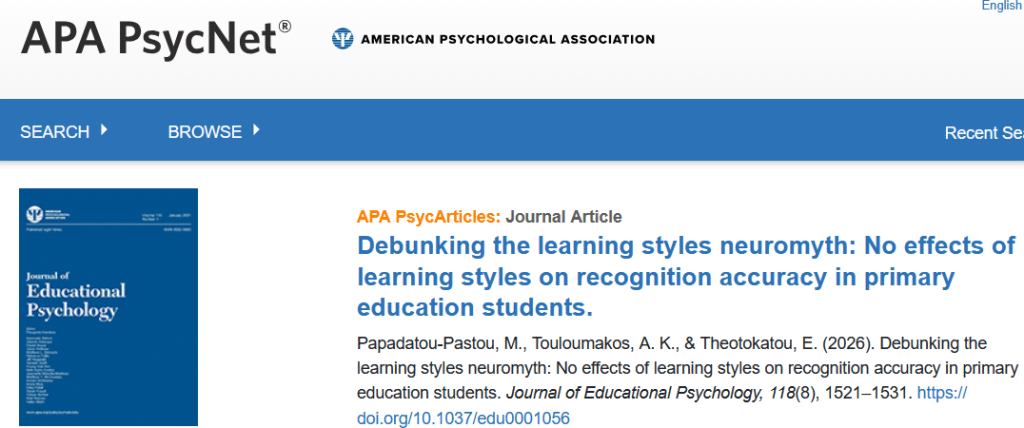

A new study by Greek researchers, published in the Journal of Educational Psychology of the American Psychological Association (APA), challenges with experimental evidence one of the most deeply rooted beliefs in education: that tailoring instruction to each pupil’s “learning style” —visual, auditory or kinesthetic— improves learning.
The study was conducted by Dr Marietta Papadatou-Pastou (Department of Pedagogy and Primary Education, National and Kapodistrian University of Athens) and Dr Anna K. Touloumakos (Panteion University of Social and Political Sciences and SKOPE Centre, University of Oxford), who share joint first authorship, together with Efthalia Theotokatou (National and Kapodistrian University of Athens). It is one of very few rigorously designed experimental studies worldwide to test this educational “neuromyth” in primary school pupils.
Belief in learning styles remains remarkably widespread. In one survey, 97% of in-service Greek teachers agreed that pupils learn better when they receive information in their preferred learning style — even though the OECD labelled the idea a “neuromyth” as far back as 2002.
The study involved 194 Year 5 and Year 6 pupils (ages 10–12) from four schools in the Attica region, two public and two private. Pupils were taught three meteorology lessons (weather forecasting, clouds and climate change) in three different formats: visual (images and text for silent reading), auditory (recorded narration) and audiovisual (both combined). Every pupil took part in all three conditions and, after each lesson, answered multiple-choice questions measuring how accurately they recognised what they had just been taught. Each pupil’s learning style was identified in two ways: by self-report and by the Barsch Learning Style Inventory.
The central question was whether “matched” instruction —teaching pupils in the format that fits their style (e.g. images for a “visual” learner)— works better than “mismatched” instruction (e.g. narration for a “visual” learner). This is precisely the assumption behind learning-styles teaching practice, known in the research literature as the meshing hypothesis.
The results were clear: pupils did not perform better when instruction matched their learning style. There was no significant difference between matched and mismatched instruction, nor the so-called “crossover interaction” that is the critical condition for the hypothesis to hold. In other words, “visual” learners did not do better with visual material, nor “auditory” learners with auditory material. Moreover, pupils could not reliably identify their own “type”: their self-reports did not agree with the classification produced by the questionnaire.
By contrast, the study found that multimodal presentation —combining visual and auditory material— significantly outperformed each single-modality format for all pupils, regardless of learning style.
Dr Anna K. Touloumakos said:
“This is the finding that should change the way we think about teaching. Multimodal learning is not just one option among many; it is the strategy that works for all pupils, regardless of how they see themselves as learners. When we provide visual and auditory information together, we draw on distinct cognitive channels and improve how information is encoded for everyone.”
The study followed the methodological criteria proposed by Pashler and colleagues in 2008 in Psychological Science in the Public Interest for a valid test of the hypothesis: classifying pupils by learning style, presenting the same content through a single sensory modality, and assessing everyone with the same test. These criteria are rarely met: a review of 1,215 relevant studies found that only 10 satisfied them, and none showed the predicted interaction.
Dr Marietta Papadatou-Pastou added:
“We deliberately followed the design proposed by Pashler precisely because it can rigorously test whether the hypothesis holds. We used a within-subjects design, counterbalanced the order of presentation and classified learning styles in two different ways — elements missing from most studies in this field. The hypothesis that pupils perform better when they receive material in the format that matches their type was not confirmed. This is a robust negative finding that the education community should take seriously.”
The findings have direct implications for education policy and teacher training. According to international research, around one in four textbooks used in teacher education programmes still recommends matching instruction to learning styles. Investing time and resources in unsupported practices is not only wasteful but may also hold pupils back: a child labelled an “auditory learner” may come to believe they cannot learn well from written or visual material. The researchers call for a shift towards evidence-based strategies that benefit all pupils, such as multimodal instruction, retrieval practice and spaced study.
For more information or to access the complete academic paper, please visit https://doi.org/10.1037/edu0001056. All data, materials and analysis code are openly available at https://osf.io/3ckgj/overview.