
How does the developing brain coordinate language, movement, and cognition during writing? And how do factors like handedness and dyslexia risk shape this process?
A study that has recently been published in the Royal Society Open Science investigates how children aged 7–9 engage the brain during writing tasks, comparing those at risk for dyslexia with typically developing peers. Using a child-friendly neurophysiological method—functional transcranial Doppler ultrasonography (fTCD)—researchers explored how linguistic and motor aspects of writing are processed across the brain’s two hemispheres. The study was led by Dr. Marietta Papadatou-Pastou, Assistant Professor in the National and Kapodistrian University of Athens, and Dr. Anastasia – Konstantina (Nantia) Papadopoulou and co-authored by a multinational team of researchers from Universities in Greece, Australia, and Canada.
Cerebral lateralization, the specialization of functions in one hemisphere of the brain, has been widely studied in spoken language. However, much less is known about how writing develops in the brain, particularly in children and in those with learning difficulties such as dyslexia.
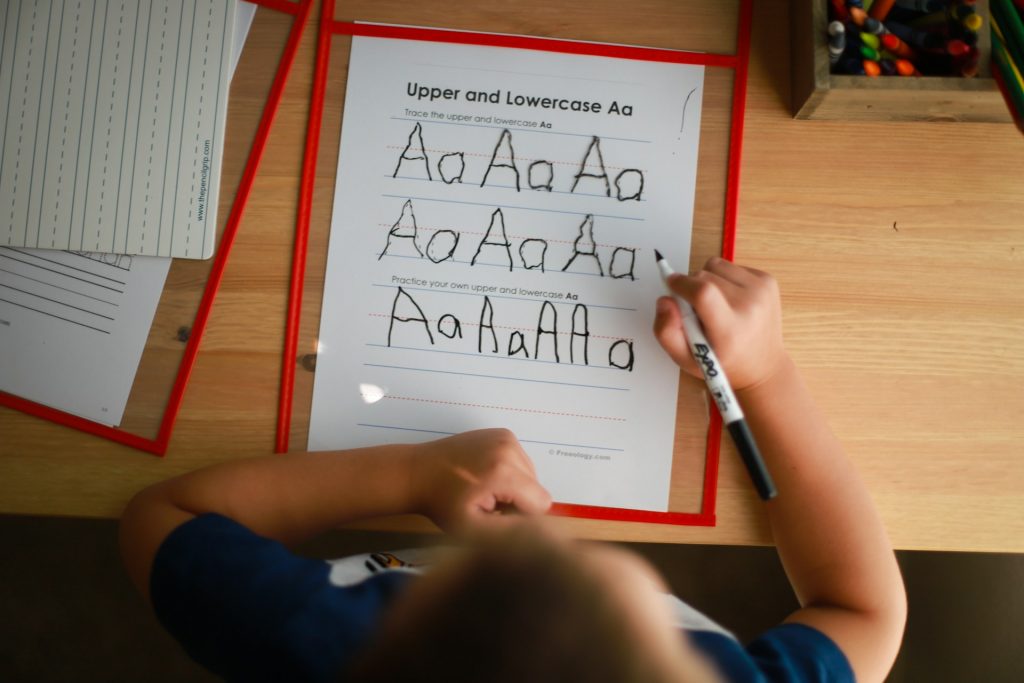
To disentangle the linguistic and motor components of writing, children were asked to perform two types of tasks: generating words based on pictures (e.g., writing “chair” after seeing a chair on screen) and copying letters (e.g., writing “aaaa” after seeing the letter “a” on screen). This design allowed researchers to examine how different aspects of writing engage the brain.
Contrary to expectations, the study found no clear differences in brain lateralization between children at risk for dyslexia and their typically developing peers. Additionally, no strong relationship emerged between brain activity patterns and writing ability. These findings suggest that, during middle childhood, the neural organization of writing remains flexible and not yet fully specialized.
One of the most notable findings was the significant role of handedness. Hand preference appeared to influence brain activity during writing, in some cases more strongly than dyslexia risk. Language-related writing processes were linked to handedness, while simpler tasks such as letter copying were associated with reading difficulties and potentially influenced by attention and emotional factors.
Importantly, the results challenge the assumption that copying letters is purely a motor activity. Instead, even basic writing tasks appear to involve a broader network of cognitive and affective processes.
The study also emphasizes that its findings relate to overall brain asymmetry between the two hemispheres, rather than pinpointing activity in specific brain regions. Future research combining methods with higher spatial resolution will be needed to better understand where and how these processes occur in the brain.
Overall, the findings highlight that writing development does not rely on a single “brain signature.” Instead, it reflects a dynamic interaction between neural, cognitive, and individual factors, underscoring the importance of adopting a broader and more inclusive perspective when studying and supporting children’s learning.
For more information or to access the complete academic paper, please visit https://doi.org/10.1098/rsos.260416.








![Complete Anatomy Training Session [October 7, 2026]](https://hub.uoa.gr/en/wp-content/uploads/2026/10/NKUA_Invite-for-Complete-Anatomy-Training-Session_page-0001-1-1024x604.jpg)