
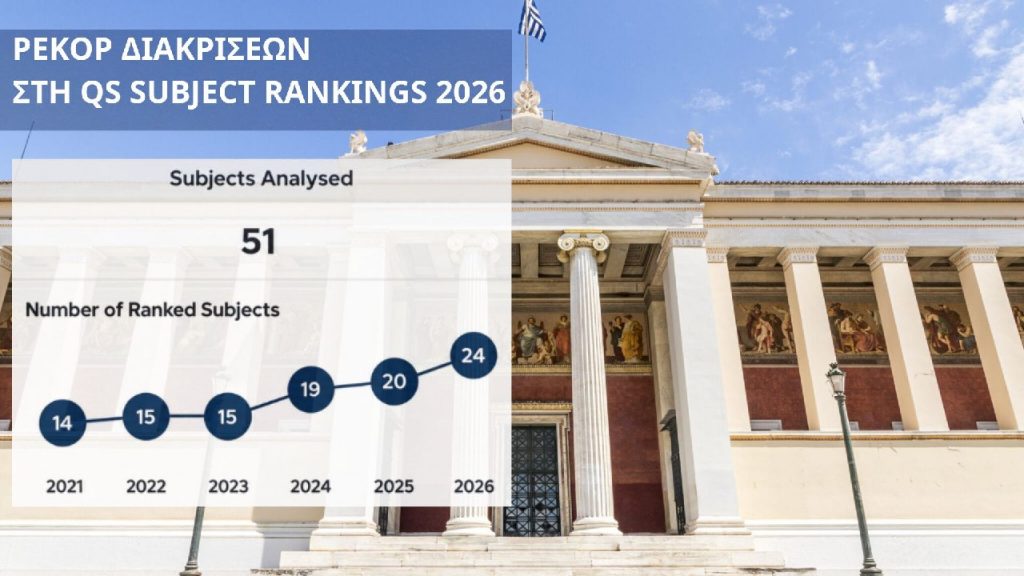

In the global top 100 in 4 subjects – ranked highly across 24 subjects
The latest Quacquarelli Symonds World University Rankings by Subject, widely regarded as one of the most authoritative international ranking systems, has been released, offering a comprehensive assessment of universities across broad subject areas and more narrowly defined subjects worldwide.
The 2026 ranking results reflect the best performance to date for the National and Kapodistrian University of Athens over the past five years, marking a record level of recognition in both scale and quality. In particular, in 2026 the University achieved strong results across 24 subjects, compared with 14 in 2021 and 15 in 2023, confirming a significant upward trajectory over the last three years.
https://www.topuniversities.com/subject-rankings
This ranking evaluates universities across five broad subject areas, as defined in the QS methodology: Arts and Humanities, Life Sciences and Medicine, Natural Sciences, Social Sciences and Management, and Engineering and Technology. It also covers 55 narrow subjects, which represent specialised disciplines nested within these five main areas.
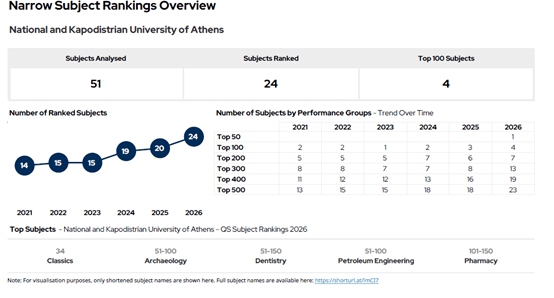
More specifically, the University of Athens’ performance is as follows:
For 2026, the University was ranked in 24 narrow subjects, up from 15 in 2023 and 14 in 2021.
In Classics and Ancient History, the University of Athens is ranked 34th globally, up from the 51–100 bracket over the previous two years.
Four subject areas at the University of Athens are ranked within the global top 100: Dentistry, Archaeology, and Petroleum Engineering (all in the 51–100 bracket), alongside Classics and Ancient History, which also sits within the global top 50, as noted above.
The University also records strong positions across all five broad subject areas, with Life Sciences and Medicine ranked 195th globally, marking an improvement of 19 places since 2022.
All four Departments of the School of Health Sciences are positioned strongly in the 2026 rankings. In addition to Dentistry, noted above, Pharmacy is ranked 101–150 in Pharmacy & Pharmacology, Medicine is placed 184th globally, and Nursing falls within the 151–225 bracket.
The subject area of Law is ranked in the 251–300 bracket, representing a rise of 100 places compared with the 2025 ranking.
The Arts and Humanities account for the largest share of the University’s new entries in the rankings, Philosophy (201–225), Linguistics (251–300), Modern Languages (251–300), and English Language and Literature (301–350).
The School of Science achieved eight notable rankings across its disciplines. Computer Science and Information Systems – and Mathematics – are placed in the 251–300 bracket; Biological Sciences and Chemistry in the 301–350 bracket; Electrical and Electronic Engineering – and Physics and Astronomy – in the 401–450 bracket; and Environmental Sciences in the 501–550 bracket.
For the first time, Politics enters the rankings, placed in the 301–400 bracket.
Education and Training – and Psychology – are ranked in the 301–350 bracket, while Economics and Econometrics are placed in the 451–500 bracket.
Agriculture and Forestry is also among the ranked subjects for 2026, placed in the 401–475 bracket.
Following the University of Athens’ strong performance in the latest rankings, the Rector of the institution, Gerasimos Siasos, made the following statement:
‘The QS rankings across both broad and narrow subject areas confirm the consistently high level of academic, research, and teaching work carried out at the National and Kapodistrian University of Athens. They also highlight the international reach and impact of the research produced at the University, as well as its recognition by both the academic community and the global labour market. I would like to extend my warm congratulations to the entire University community on this achievement. The particularly high number of distinctions in this ranking is closely linked to the University’s strategy of internationalisation and outward engagement in recent years. The development and delivery of study programmes in foreign languages, at both undergraduate and postgraduate level, has strengthened the University’s international presence and attractiveness, drawing students and academics from abroad. At the same time, the institution’s sustained internal policy of enhancing research quality, improving publication output, and fostering international collaboration has played a key role in the continued rise of the University in global rankings.’
For the 2026 subject rankings, a total of 1,908 universities from 166 countries were evaluated. The results are based on survey responses from 151,000 academics and 100,000 employers, as well as the analysis of 16.5 million scientific publications indexed in the Scopus bibliometric database, covering a five-year citation window.
The QS rankings draw on data collected from a large international pool of researchers, academics, and employers. They also take into account citation counts and the research impact of published work produced by the academic staff of each School or Department. More specifically, four indicators are assessed, each carrying a different weighting.
1.Academic reputation: This indicator is measured through a global academic survey in which scholars from a wide range of disciplines are asked to identify up to 30 leading universities in their respective fields of expertise, excluding their own institution. Between 2021 and 2025, QS collected responses from approximately 151,000 academics worldwide. For the 2026 rankings, the weighting assigned to this indicator ranges from 30 to 90 per cent, depending on the broad or narrow subject area assessed.
2.Employer reputation: This indicator is based on a global survey of employers and follows a methodology similar to that of the academic reputation indicator. More than 100,000 employer responses collected between 2021 and 2024 were taken into account for the 2026 rankings. The survey provides valuable insight into graduate employability and recruitment preferences across different sectors of the global economy. Participating employers include major international companies such as Facebook, Google, Wells Fargo, and Bank of America, among others. Depending on the broad or narrow subject area assessed, the weighting assigned to this indicator ranges from 10 to 50 per cent.
3.Research citations per paper: This indicator is based on data drawn from the Elsevier Scopus database and measures the research impact of published work across a specific subject area. QS calculates the total number of citations received over a five-year period for publications authored by members of the University’s academic staff in the relevant discipline and divides this figure by the corresponding number of researchers and faculty members. For the 2026 rankings, the weighting assigned to this indicator ranges from 0 to 30 per cent, depending on the broad or narrow subject area assessed.
4.H-index: This indicator measures both the productivity and the scholarly impact of an academic or researcher. It is calculated on the basis of their most highly cited publications and the number of citations these works receive in other academic publications. For the 2026 rankings, the weighting assigned to this indicator ranges from 0 to 25 per cent, depending on the broad or narrow subject area assessed.
5.International research network (IRN): Introduced to the subject rankings methodology for the first time this year, the IRN indicator measures the extent to which universities succeed in building sustained international research collaborations. For the 2026 rankings, the weighting assigned to this indicator ranges from 0 to 10 per cent, depending on the subject area assessed.


![Complete Anatomy Training Session [October 7, 2026]](https://hub.uoa.gr/en/wp-content/uploads/2026/10/NKUA_Invite-for-Complete-Anatomy-Training-Session_page-0001-1-1024x604.jpg)




![‘Dialogues for Athens’ Conference Organised by TO VIMA Under the Auspices of the National and Kapodistrian University of Athens and the Municipality of Athens [6-7 October]](https://hub.uoa.gr/en/wp-content/uploads/2026/10/Untitled-Design2-1-1024x576-1.jpg)